Classic Atari video games
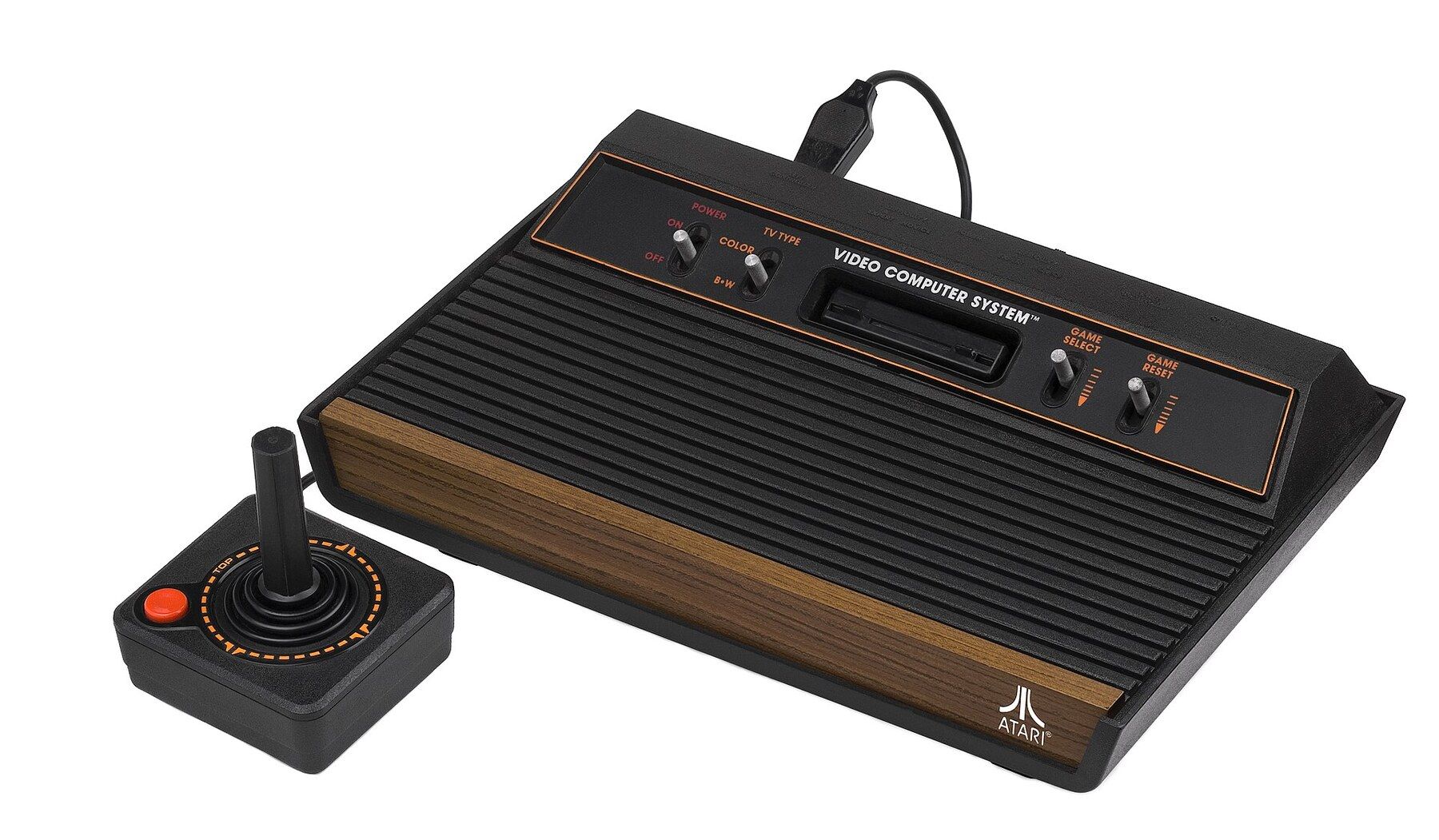
This page lists the Atari home games that changed something, for the company or for the cartridge business, from Combat in 1977 to the Jaguar titles of 1994, grouped by machine. Most of the VCS and 8-bit games below were published by Atari, Inc.; the 7800, ST, Lynx and Jaguar games came from Atari Corporation and its licensees. Each entry gives the release date, the programmer or studio when a source names one, and what the game brought or set off. Coin-operated games have their own arcade catalog.
VCS games, 1977 to 1983
The Video Computer System, later sold as the Atari 2600, ran its games from ROM cartridges. Atari, Inc. did not print programmers’ names on its packaging; the names below come from interviews and later research.
| Game | Released | Programmer | What it brought or caused |
|---|---|---|---|
| Combat | 1977 | Larry Wagner, on a display engine by Joe Decuir | Packed with the console until 1982; its tank game is a home version of Tank, the 1974 coin-op of Atari’s Kee Games subsidiary |
| Space Invaders | March 1980 | Rick Maurer | Licensed from Taito; its success turned Atari and its competitors toward licensed arcade conversions |
| Adventure | March 1980 | Warren Robinett | A hidden room carrying the programmer’s name, the first secret in a commercial game to be found around the time of its release |
| Pac-Man | April 1982 | Tod Frye | Namco license; Atari produced 12 million cartridges, and the game is often cited among the causes of the 1983 crash |
| Yars’ Revenge | May 1982 | Howard Scott Warshaw | Began as a port of Cinematronics’ Star Castle; shipped with a comic book built on its storyline |
| Swordquest: EarthWorld | October 1982 | Dan Hitchens, from a design by Tod Frye | First game of a four-part series tied to comics and a prize contest |
| Raiders of the Lost Ark | November 1982 | Howard Scott Warshaw | Played with two joysticks: one moves Indiana Jones, the other handles the inventory |
| E.T. the Extra-Terrestrial | Late 1982 | Howard Scott Warshaw | Written in five and a half to six weeks and produced in quantities far above its sales |
The Atari Archive dates Combat to August 1977, from the earliest newspaper advertisements for the console; Wikipedia gives September 11, 1977 for the launch of the VCS itself, so the month of the launch is still argued over.
Space Invaders led Atari’s VCS campaign for the fall of 1980: its own television commercial, print advertisements and a National Space Invaders competition with qualifiers across the United States and a final in New York, won by Rebecca Heineman. The Atari Archive estimates that the cartridge sold about 6.2 million copies over the life of the console, second among VCS games only to Pac-Man, and that its success led Atari and its competitors to license arcade games for home conversion.
Adventure and Warren Robinett’s signature
Robinett has said that his manager thought a graphical version of the text game Adventure was impossible on a machine with 4 KB of ROM and 128 bytes of RAM, and that he wrote it anyway. Atari, Inc. released the cartridge in March 1980, after Robinett had left the company around June 1979.
He hid his name in a room reachable only by carrying a one-pixel object, the “gray dot”, through a wall. In his account, the contrast was with Activision, whose cartridges and manuals named and pictured their programmers, while Atari’s did not. In August 1980 Atari received a letter from a teenager, Adam Clayton, explaining how to reach the room. Steve Wright, then head of the VCS programming staff, argued that hidden surprises would sell games, and Robinett has said that a new ROM mask would have cost US$10,000. The room stayed, and Atari, Inc. programmers were encouraged to hide more of what the company began calling easter eggs. It was not the first hidden message in a video game: the Atari Archive points to earlier ones in Atari’s Star Ship coin-op and in Fairchild Channel F cartridges.
Pac-Man, E.T. and the overproduction of 1982
Atari, Inc. marked the release of the VCS Pac-Man on April 3, 1982 with “Atari National Pac-Man Day” and costumed characters in 27 cities, according to Michael Current’s chronology. The Computer History Museum states that Atari produced 12 million cartridges in the hope that the game would sell consoles, that its flickering graphics put buyers off, and that some point to the flood of unsold Pac-Man cartridges as a cause of the 1983 crash.
E.T. followed the same pattern on a shorter schedule. Warshaw has said the license deal with Steven Spielberg was completed in late July 1982 and that Atari, Inc. wanted the game out by September 1, leaving about five and a half weeks of development (the interviewer’s question in The Atari Compendium rounds this to six weeks). The editor of his interview dates the arrival in stores to late November or early December 1982, after ten weeks of manufacturing, and adds that Atari, Inc. reportedly paid US$22 million for the license. The sales figures disagree: Warshaw recalled about 1.5 million copies sold out of roughly 4 million made, while an editorial note in the same interview cites internal documents shown in Warshaw’s documentary Once Upon Atari recording more than 2.5 million sold in 1982 and about 1 million more in 1983 and 1984. In April 2014 a dig at the landfill in Alamogordo, New Mexico, where Atari, Inc. had dumped material in 1983, recovered E.T. cartridges. The video game crash page covers what these numbers did to Atari, Inc.
Swordquest and the contest Atari never finished
Swordquest was a four-game series conceived by Tod Frye, each cartridge packed with a DC Comics book whose pages hid clues. Players who solved a game could enter a contest for a prize made by the Franklin Mint. Scott Stilphen’s history of the series gives the dates and outcomes:
| Game | Released | Contest |
|---|---|---|
| EarthWorld | October 1982 | Final held in Sunnyvale on May 2, 1983, won by Steven Bell |
| FireWorld | February 1983 | Final held in San Francisco in January 1984, won by Michael Rideout |
| WaterWorld | October 1983, sold only through Atari Age, Atari’s club magazine | Never held |
| AirWorld | Cancelled, about 20 percent complete | Never held |
Each contest prize was valued at US$25,000, and a Sword of Ultimate Sorcery worth US$50,000 was to go to the winner of a final play-off between the four champions in 1984. That play-off never took place. According to Rideout, quoted in Stilphen’s article, when Atari discontinued the contests he and Steven Bell each received a check for US$15,000, and the WaterWorld qualifiers smaller ones (around US$2,000, in Rideout’s recollection); Stilphen adds that Bell stated on a 2024 podcast that he received a US$15,000 settlement offer in October 1986. The archived Atari Historical Society page on the series reprints the announcement published in Electronic Games in December 1982.
Activision and the first third-party cartridges
Activision was founded in October 1979 by four Atari, Inc. programmers, David Crane, Larry Kaplan, Alan Miller and Bob Whitehead, with Jim Levy, a former music industry executive, according to Guinness World Records. Michael Current’s chronology names Crane, Miller and Whitehead as co-founders and says Kaplan helped form the company and joined it in December 1979. Its first three cartridges, Dragster, Fishing Derby and Boxing, came out in July 1980 and made Activision the first independent publisher of console games. Atari, Inc. sued Activision for US$20 million in May 1980; Current records a settlement in December 1981.
Atari 8-bit computer games
Star Raiders is the 8-bit game most often tied to the Atari 400 and 800. Doug Neubauer, who had led the chip design of POKEY at Atari, Inc., told ANALOG Computing that he began designing it in early 1979. Atari introduced it at the Winter CES in January 1980 and, according to Current, shipped it around February 1980; some references date it to 1979, the year it was written. Electronic Games named it Computer Game of the Year in March 1982, and in June 1982 Atari announced a 2600 version sold with the Video Touch Pad keypad controller. Neubauer later wrote Solaris for the 2600, which ANALOG reported as just finished in 1986.
Two third-party games of 1983 are worth listing because they used the machine’s hardware:
- M.U.L.E. (Ozark Softscape, Electronic Arts, 1983): an economic strategy game for up to four players. Creative Computing noted in December 1983 that four people could only play on the 400 and 800, which have four joystick ports; the XL models have two.
- Archon (Free Fall Associates, Electronic Arts, 1983): a chess-like board where captures are decided by an action fight. Hi-Res reviewed it in 1984 as a 32 KB disk for the Atari 400, 800 and 1200 and the Commodore 64, at US$40.
Games for the 5200 and 7800
The Atari 5200 shipped in October 1982 with Super Breakout packed in. Galaxian, Missile Command, Space Invaders and Star Raiders were sold alongside it, and Pac-Man followed in November. At the June 1983 Summer CES Atari, Inc. cut the price to US$199 and replaced Super Breakout with Pac-Man as the packed-in game.
The Atari 7800 had a longer gap between announcement and sale. Atari, Inc. introduced it on May 21, 1984 with 13 announced games, including Asteroids, Centipede, Dig Dug, Food Fight, Galaga, Joust and Ms. Pac-Man. After the sale to Jack Tramiel, Atari Corporation shipped it in 1986 with Pole Position II. Desert Falcon followed in 1987 and Lucasfilm’s Ballblazer in 1988, according to Current.
Atari ST games
Two Atari ST games drew on features of the machine that magazines of the time singled out:
- Dungeon Master (FTL): a dungeon game played in real time rather than turn by turn. START reported in September 1988 that, except for one week, it had been number one in the European Gallup ST sales chart since its March release there. The sources consulted do not establish the US release date.
- MIDI Maze (Xanth Software F/X, published by Hybrid Arts): a first-person maze game for up to 16 players, each on an ST, connected by cables through the MIDI ports that every ST has. ANTIC listed it among new ST products at US$39.95 in December 1987.
Lynx and Jaguar games
The Lynx, a color handheld that Dave Needle and R.J. Mical began designing at Epyx in 1987 as the “Handy” project, went on sale from Atari Corporation in November 1989 with California Games packed in. Blue Lightning, The Gates of Zendocon, Electrocop and Chip’s Challenge were the other launch titles, according to Current, and the Los Angeles Times reported that the first units were only supplied to the New York and Tokyo areas.
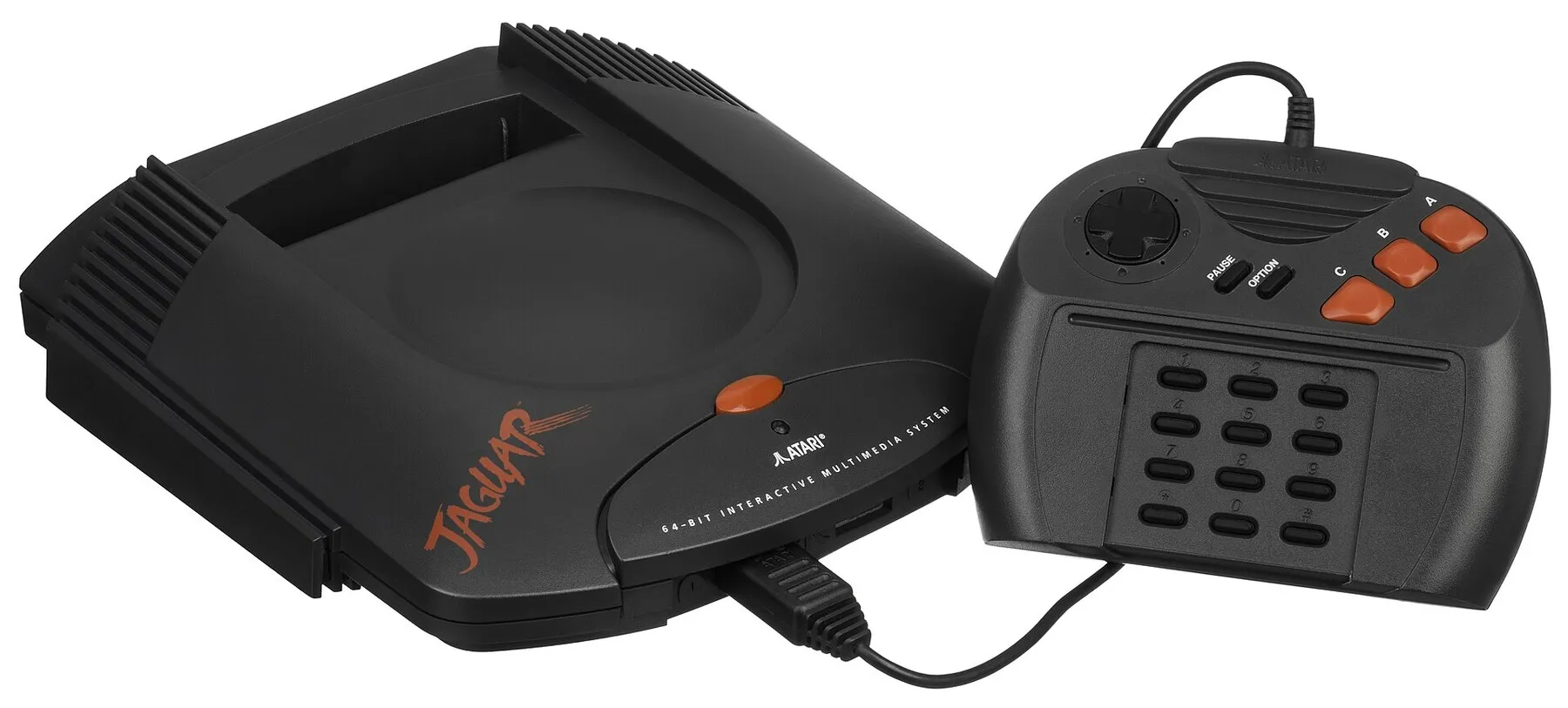
The Atari Jaguar launched in New York and San Francisco in late November 1993 with Cybermorph, by Attention to Detail, packed in. Its best-known games came in 1994:
| Game | Released | Developer | What it brought or caused |
|---|---|---|---|
| Tempest 2000 | 1994, on sale by July | Jeff Minter (Llamasoft) | Remake of the 1981 Atari coin-op; Wired called it the fifth Jaguar title and the first worth playing |
| Alien vs. Predator | October 21, 1994 | Rebellion | Based on the Alien and Predator film licenses; packed with the Jaguar in Japan from December 1994 |
| Doom | December 1994 | id Software | Port of id Software’s PC game, announced as shipping on December 2, 1994 |
Atari Corporation’s own annual report for 1994 does not settle which of the first two sold best: it calls Alien vs. Predator “currently the best selling title for Jaguar” and, a few paragraphs later, Tempest 2000 “the Jaguar top-selling title”.
Box art and the Art of Atari
Atari, Inc. sold its cartridges in boxes with painted illustrations. Nolan Bushnell told Polygon that he wanted each game treated with the care of a record album and the packaging to be recognizable as Atari at a glance. Tim Lapetino’s book The Art of Atari (Dynamite Entertainment, October 2016, 352 pages, ISBN 978-1-50670-123-3) collects the paintings, sketches and unused versions and interviews the artists. Among the names it brings back are Cliff Spohn, who painted the first VCS Breakout box, Steve Hendricks, Burrell Dickey for Centipede and Hiro Kimura for the airbrushed Yars’ Revenge. Stilphen credits the Swordquest: EarthWorld packaging to Warren Chang. The archived Atari Historical Society pages on Atari artwork, which old links to /artwork/ pointed to, showed artists’ renderings, including art for the unreleased Swordquest: AirWorld.
Telling 2600 cartridge label variations apart
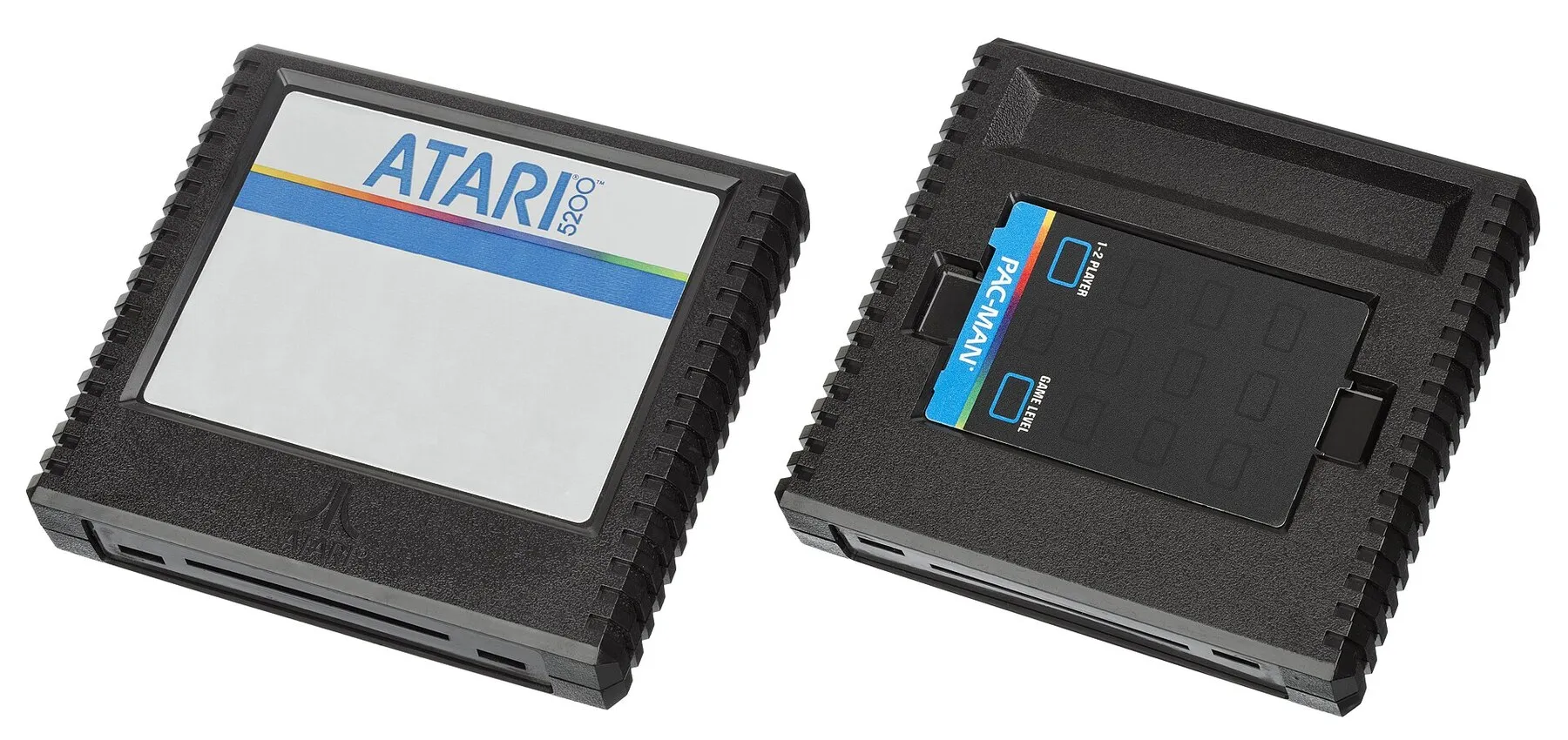
Collectors date VCS cartridges by their label style. AtariAge’s label guide describes the main Atari styles:
| Label | Period | How to recognize it |
|---|---|---|
| Text with number | 1977 | The nine launch games; plain colored text and a number on the end label (Combat is 01), sold in gatefold boxes |
| Text | From 1978 | Colored text on black with a gray border, in standard top-opening boxes |
| Picture | From 1981 | Same lettering with a picture in the center; no border |
| Silver | 1982 to 1985 | Silver or gray background, title in white on a red stripe |
| Red | 1986 to 1990 | Red to red-brown background, monochrome pictures in the first year, then color |
Many games exist in two styles, so a label dates a particular cartridge, not the first release of the game. The Red labels belong to Atari Corporation’s attempt to revive the 2600 from 1986, the year it also put the 7800 on sale.
Sources
- Combat/Tank-Plus (August 1977), Atari Archive (Kevin Bunch)
- Space Invaders (March 1980), Atari Archive (Kevin Bunch)
- Adventure (March 1980), Atari Archive (Kevin Bunch)
- Interview with Warren Robinett, Adventure Game Shrine (toadstool.net)
- Pac-Man game cartridge, Computer History Museum, Revolution exhibit
- Interview with Howard Scott Warshaw, The Atari Compendium
- Raiders of the Lost Ark instruction manual, AtariAge, 1982
- SwordQuest Revisited (Scott Stilphen), The Atari Compendium, updated December 1, 2025
- The Atari Swordquest Challenge (archived Atari Historical Society page, reprinting Electronic Games, December 1982), Internet Archive, captured May 2000
- First third-party videogame console developer, Guinness World Records
- A History of WCI Games / Atari / Atari Games / Atari Holdings, Michael Current, Atari History Timelines
- A History of Tramel Technology / Atari, Michael Current, Atari History Timelines
- An Interview with Doug Neubauer, ANALOG Computing, via Atari Gaming Headquarters, October 1986
- M.U.L.E. (review by John J. Anderson), Creative Computing, vol. 9 no. 12, December 1983
- Reviews: Archon, Hi-Res, vol. 1 no. 4, May/June 1984
- Into the Dungeon With You! The Dungeon Master Experience, START, vol. 3 no. 2, September 1988
- ST New Products, ANTIC, vol. 6 no. 8, December 1987
- Lynx Creators: an interview with Dave Needle and R.J. Mical (reprinted by The Atari Times), Electronic Gaming Monthly no. 4, via Internet Archive, September 1989
- Taking On Nintendo, Los Angeles Times, April 30, 1990
- Tempest in a Game Box, Wired, July 1994
- Atari Corporation annual report (Form 10-K) for 1994, U.S. Securities and Exchange Commission, 1995
- Atari 2600 label variations, AtariAge
- Inside The Art of Atari, Polygon, July 4, 2016
- Review: 'Art of Atari' HC, ICv2, October 27, 2016
- The Art of Atari (archived Atari Historical Society page), Internet Archive, captured March 2000
- Unearthing the Atari Tomb, The Henry Ford
- Atari 2600, Wikipedia
Last reviewed October 30, 2026.
Related pages
- Atari 2600 (Video Computer System)
Atari, Inc.'s cartridge console of 1977: a 6507 processor, 128 bytes of RAM and the TIA video chip, dropped in the United States at the end of 1991
- Atari 8-bit computer family
Atari's 6502 home computers, from the 400 and 800 of 1979 to the XE Game System of 1987, all built on ANTIC, CTIA or GTIA, and POKEY
- Atari Jaguar
Atari Corporation's cartridge console with Tom and Jerry chips by Flare II, sold as 64-bit from November 1993, with production orders stopped in mid-1995
- Atari and the video game crash of 1983
Warner's December 1982 warning, the cartridge glut, the Alamogordo burial and the July 1984 sale, with the documented figures kept apart from the legends
- Atari arcade games
The main Atari coin-op cabinets from Pong in 1972 to Hard Drivin' in 1989, with their display technology and what each one introduced