Atari 5200 SuperSystem
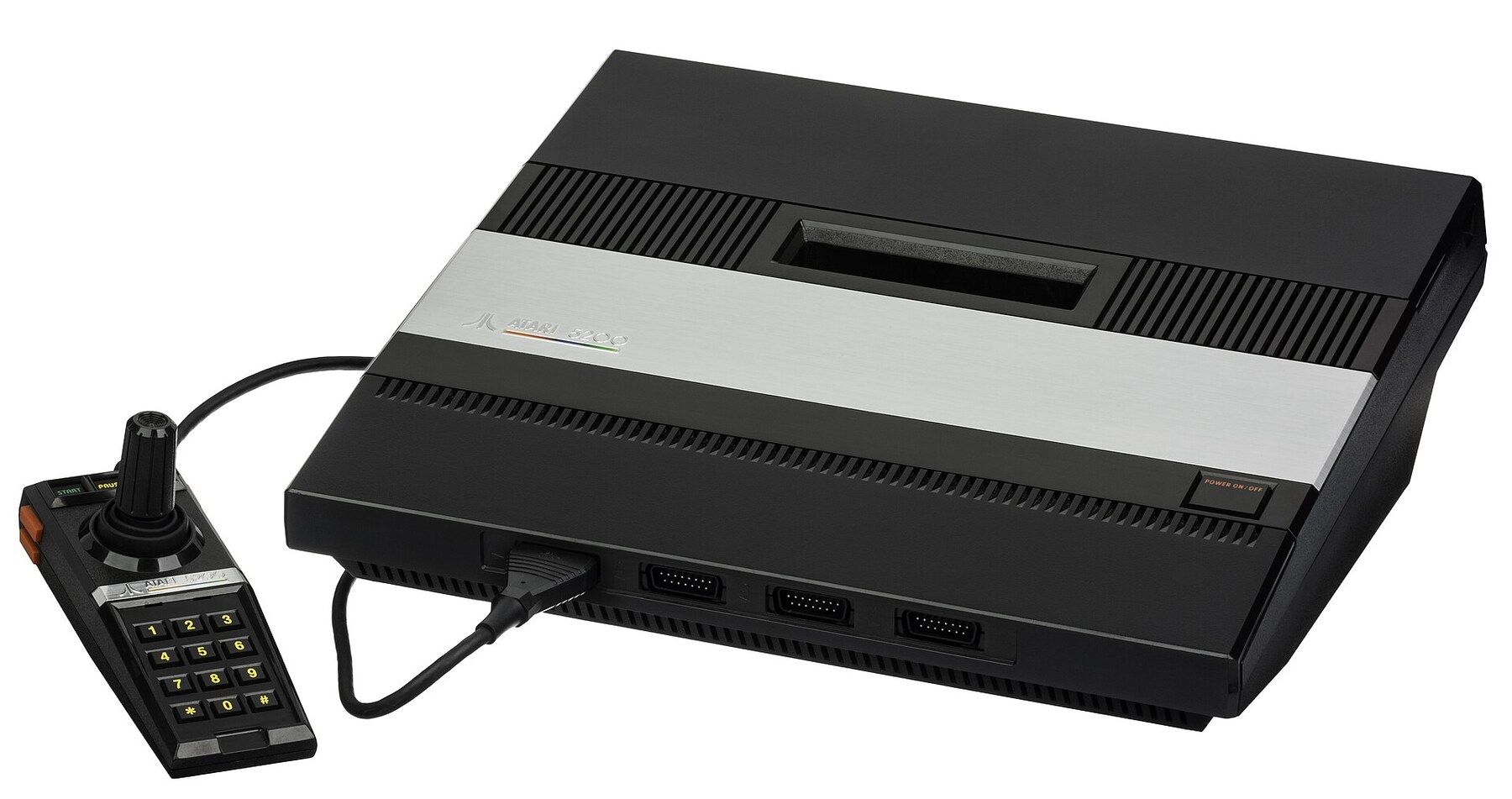
The Atari 5200 is the console Atari, Inc. shipped in October 1982 as a more powerful companion to the 2600. Inside, it used the custom chips of the Atari 400 and 800 computers, ANTIC, GTIA and POKEY, with 16 KB of RAM, but its cartridges and controllers fit neither the computers nor the 2600. Atari, Inc. stopped building it in early 1984, about a year and a half after launch.
Atari, Inc. used several names for it. Current’s timeline records the first consoles shipping as the “5200 Advanced Video Entertainment System”, David Ahl’s review in Creative Computing called it the “Advanced Game System”, and by 1984 ANALOG Computing and the Washington Post used “SuperSystem”.
From the PAM project to the 5200
The machine began around the summer of 1981 as project “PAM”, for Personal Arcade Machine, also called Video System X, in the advanced technology group of Atari, Inc.’s consumer division. Pete Gerrard was the lead engineer and Rob Zdybel wrote the operating system (Current). An archived Atari Museum page says the first version of the design, which it also links to the names Super-Stella and Sylvia, was to have built-in 2600 compatibility, and that it was dropped in favor of a system built on the 400/800 chipset.
The price came down before launch. Atari, Inc. previewed the “Supergame System” at the January 1982 Consumer Electronics Show at US$349.95, and at the Summer CES on June 8, 1982 introduced the “5200 Home Entertainment System” at US$299.95, with two controllers and Super Breakout, to ship in October. It also announced a Trak-Ball, a voice synthesizer that was never released, and an adapter for 2600 cartridges (Current).
Atari, Inc. shipped the four-port console in October 1982, with Galaxian, Missile Command, Space Invaders and Star Raiders sold separately (Current; Atari Archive, from Computer Entertainer). Wikipedia, citing Computer Entertainer of November 1982, says the first run was small and the console reached stores nationwide only in January 1983.
A 400 computer in disguise
Ahl wrote in the spring of 1983 that the 5200 was “a 400 computer in disguise”, and that Atari, Inc. had changed the shape of the cartridges so that computer cartridges carrying the same program would not fit. Claus Buchholz’s technical description in ANALOG Computing in January 1984 gives the detail:
- The 5200 has the same VLSI chips as the 400/800 except the 6520 PIA, which handled joysticks on the computers.
- Its 6502C has the bus logic built in that the 400/800 needed four extra chips for; Atari, Inc. used the same processor in the XL computers.
- The 16 KB of RAM sits at the same addresses as in an unexpanded 400.
- ANTIC sits at the same addresses, but GTIA moves from page $D0 to $C0 and POKEY from $D2 to $EB.
- The 2 KB on-board ROM holds only the character set and a monitor program; a cartridge can be up to 32 KB.
- An edge connector behind a small rear door carries POKEY’s serial lines, which Buchholz read as a sign of planned expansion.
Cartridges can be changed with the power on, because two contacts on the cartridge board act as a power switch and reset signal. Ahl praised the single cable from the console to a TV switch box, which also takes the power supply, but noted that the box made it hard to keep a 2600 connected to the same television. John Anderson, writing in Creative Computing in March 1984, said the 5200 was “very nearly an Atari 800” inside but that “all compatibility and expandability had been designed out”.
The analog controller
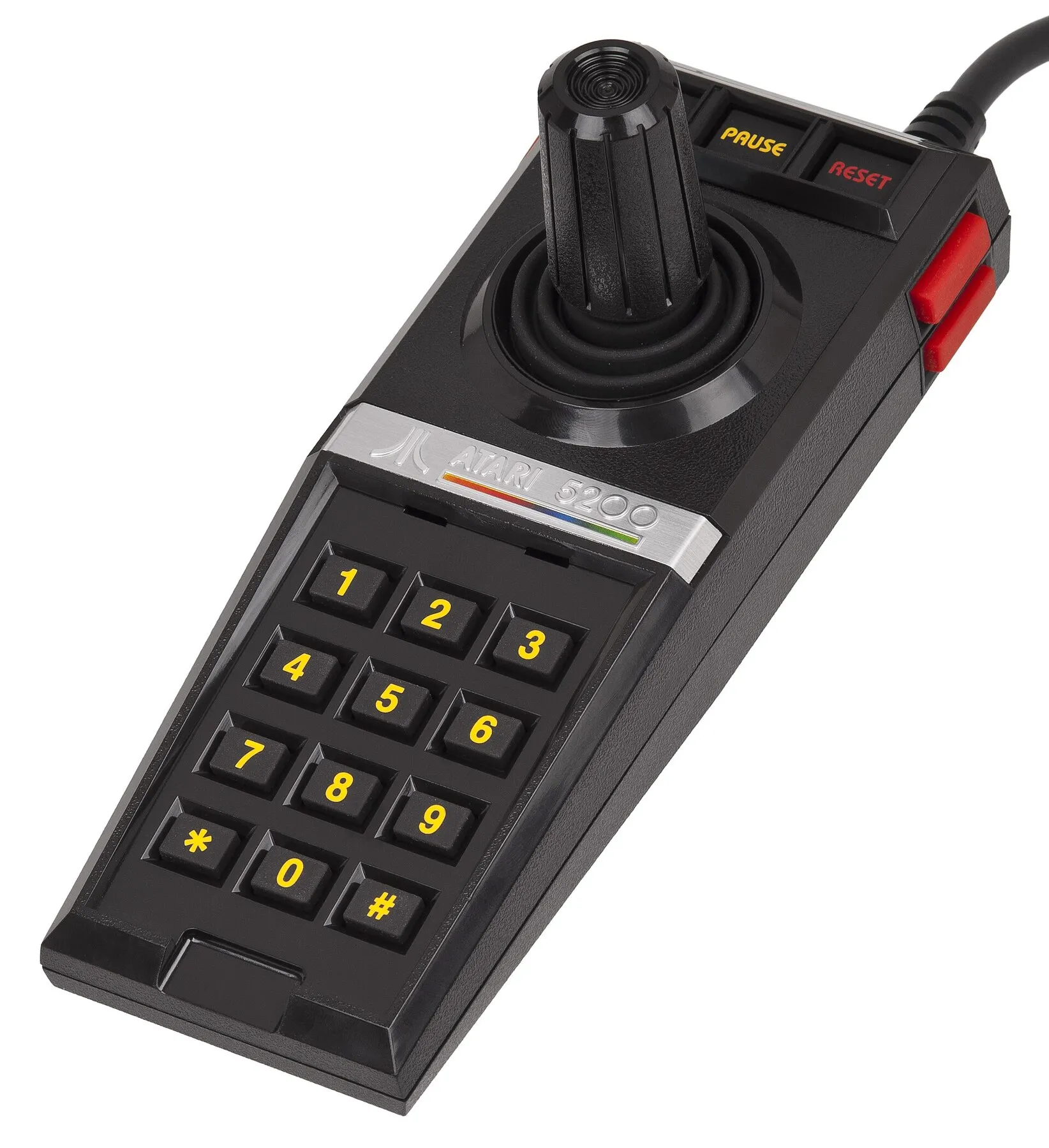
Each controller has an analog joystick read through two of POKEY’s potentiometer inputs, one for each axis, a twelve-key keypad, Start, Pause and Reset keys, and two pairs of fire buttons. It plugs in with a 15-pin connector. The stick does not spring back to the center: in June 1983 Atari, Inc. announced a self-centering version with a more durable boot, the CX52L, which never shipped (Current).
The reviews were mixed to hostile. Ahl put the stick’s travel at about 30 degrees and wrote that it “cannot be precisely moved to more than about 30 locations across the screen–60 at most”, while adding that it was “at least as good as many other controllers on the market”. One of his pre-production controllers had a pinched ribbon connector that destroyed a circuit trace. Anderson called it “an absolutely atrocious new game controller”. Ahl also questioned the choice of Super Breakout as the pack-in game, since it did little with the console’s graphics.
Two ports, US$199 and the 2600 adapter
At the Summer CES in June 1983, Atari, Inc. cut the price to US$199, replaced Super Breakout with Pac-Man in the box, and said new consoles would have two controller ports instead of four. It also introduced the CX55 VCS Cartridge Adaptor, which plays 2600 games (Current). Atari Archive, citing Computer Entertainer, dates the Trak-Ball to June 1983 and the adapter to August 1983.
Buchholz described the revised console in ANALOG in February 1984: ports 3 and 4 were gone, three pins on the cartridge connector had been changed for the new 2600 adapter, and the board had room for a PAL version for Europe, which Atari, Inc. never shipped (Current). An archived Atari Museum page says the CX55 worked only on a two-port console or a modified four-port one, that Atari, Inc.’s service centers modified four-port consoles free of charge, and that the modification, devised by engineer Gary Rubio, saved a stock of four-port boards from being scrapped.
The games
Atari Archive’s list, drawn mostly from Computer Entertainer, counts 69 games released for the 5200 between October 1982 and 1987. Besides Atari, Inc.’s own titles, the list includes games from outside publishers, Activision among them. Pac-Man and RealSports Soccer were in stores by late November 1982, alongside the four launch titles. After Bounty Bob Strikes Back in April 1985, the list has only three more games, all from Atari Corporation.
Out of production in 1984
The New York Times reported that Atari, Inc. officials “disclosed for the first time” on May 21, 1984, at the press event for the Atari 7800, that the 5200 was no longer in production; the Washington Post added that more than one million had been sold. In July 1984 the Wall Street Journal wrote that it had gone out of production in February and listed it among the products Jack Tramiel was expected to drop (Current).
Atari Corporation still sold what was left. In March 1985, with the stock of finished consoles largely used up, it began building new 5200s from leftover parts (Current). It shipped Ballblazer and Rescue on Fractalus! in the fall of 1986 and, as its last 5200 products, Gremlins and a run of controllers made in Mexico. Current and Atari Archive place Gremlins in 1987, the latter from Atari Corporation’s internal sales figures; Wikipedia gives 1986.
The 3600 name
The “3600” designation did not belong to the 5200, whose internal names were PAM, Video System X and Supergame System. Atari, Inc.’s engineers used 3600 for the console that General Computer Corporation was developing in September 1983, introduced in May 1984 as the 7800 ProSystem (Current). An archived Atari Historical Society page instead applies the number to Sylvia, the scrapped successor project that Atari, Inc.’s model-number memo of February 1, 1982 lists as the 3200, and shows a 7800 prototype cartridge board printed “Atari system 3600”; the same page notes that Atari reused the designation for several designs.
Sources
- Atari 5200 Advanced Game System, Creative Computing Video & Arcade Games, vol. 1 no. 1 (David H. Ahl), Spring 1983
- Transporting Atari Computer Programs to the 5200, and 5200 Article Update (Claus Buchholz), ANALOG Computing, nos. 15 and 16, January and February 1984
- Atari., Creative Computing, vol. 10 no. 3 (John J. Anderson), March 1984
- Atari Video Game Unit Introduced, The New York Times, May 22, 1984
- Atari Introduces Game In Attempt for Survival, The Washington Post, May 22, 1984
- A History of WCI Games / Atari / Atari Games / Atari Holdings, Michael D. Current, compiled from period sources
- A History of Tramel Technology / Atari, Michael D. Current, compiled from period sources
- Atari Model Numbers for 1982 (internal memo, John Hayashi to Ron Stringari), Atari, Inc. Consumer Electronics Division, via Atari Museum, February 1, 1982
- Atari 5200 game release dates (Kevin Bunch), Atari Archive
- Atari CX-55 2600 Cartridge Adapter for the Atari 5200 Supersystem (archived), Atari Museum, via Internet Archive, captured July 2004
- The Atari 3600 System (archived Atari Historical Society page), Internet Archive, captured June 2002
- Atari 5200, Wikipedia
Last reviewed October 30, 2026.
Related pages
- Atari consoles
Home Pong, the 2600, 5200, 7800 and Jaguar, the Lynx handheld, the XE Game System, and the consoles Atari announced but never shipped
- Atari 2600 (Video Computer System)
Atari, Inc.'s cartridge console of 1977: a 6507 processor, 128 bytes of RAM and the TIA video chip, dropped in the United States at the end of 1991
- Atari 7800 ProSystem
Designed by General Computer Corporation, announced by Atari, Inc. in May 1984 and sold by Atari Corporation from 1986, with 2600 compatibility built in
- Atari 400 and 800
Atari's first home computers, announced late in 1978 and shipped from October 1979: a sealed, low-cost 400 and an expandable 800 on the same chips
- Atari and the video game crash of 1983
Warner's December 1982 warning, the cartridge glut, the Alamogordo burial and the July 1984 sale, with the documented figures kept apart from the legends