Atari computers
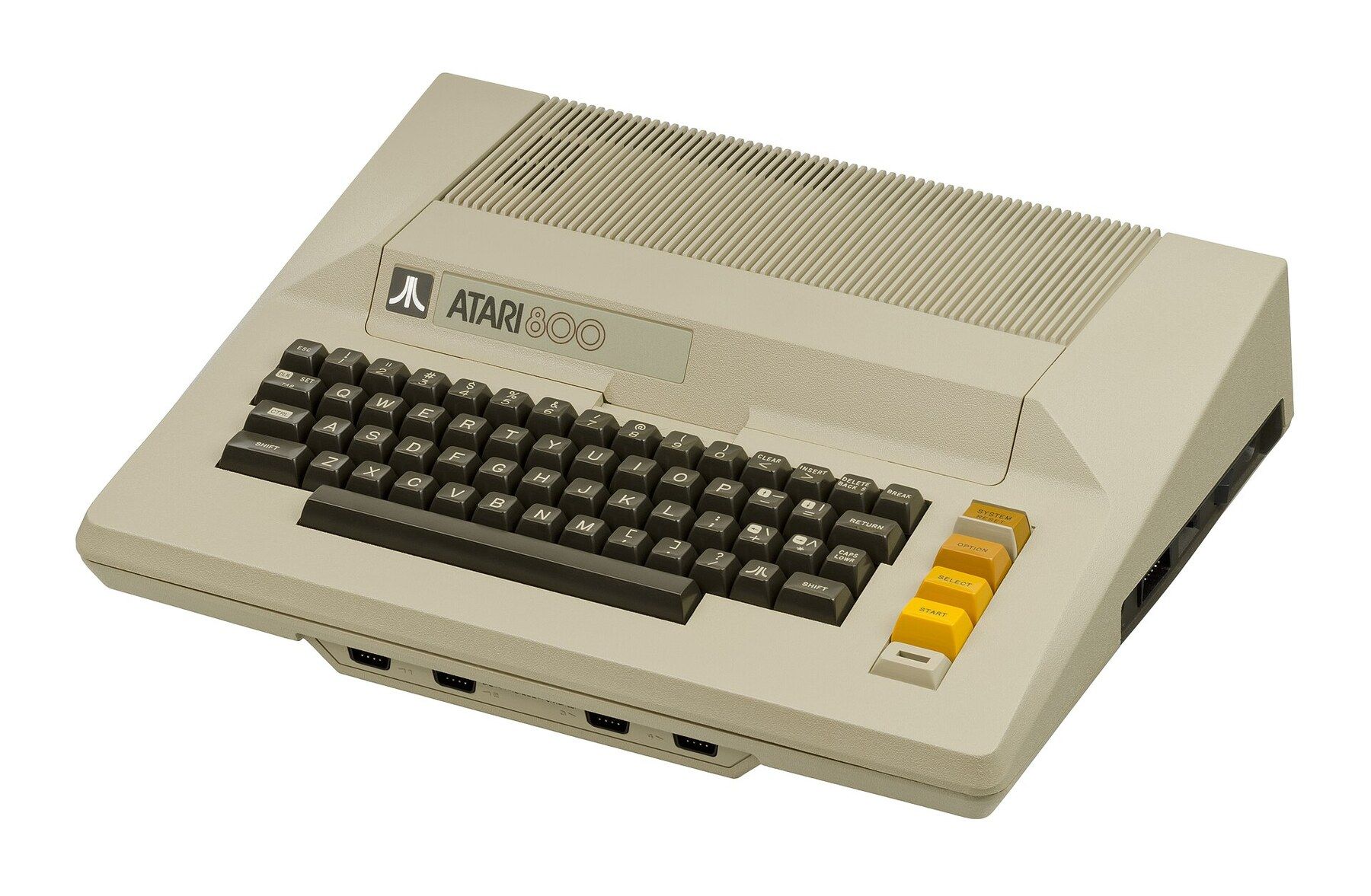
Atari, Inc. and then Atari Corporation sold two main families of computers. The 8-bit line began with the Atari 400 and 800, shown at the Winter Consumer Electronics Show in January 1979 and sold by Atari, Inc. from the fall of that year; it went on through the 1200XL and the XL models, and Atari Corporation kept it alive after July 1984 with the XE line until, according to Z*Magazine, it officially dropped the 8-bit computers at the start of 1992. The ST family, Atari Corporation’s own design, ran from the 520ST of 1985 to the Falcon030 and ended in 1993. This page covers the smaller lines that have no page of their own: the PC compatibles, the Portfolio palmtop, the transputer workstation and the prototypes that never shipped.
Atari PC compatibles, 1987 to 1991
Atari Corporation announced an IBM PC-XT compatible, the Atari PC, at CES in January 1987, alongside the Mega ST. ANTIC described an 8088 processor switchable between 4.77 and 8 MHz, 512 KB of RAM expandable to 640 KB, a 5.25-inch 360 KB drive, a mouse, and EGA, CGA, Hercules and IBM monochrome graphics built in. It was announced at US$499 for the keyboard and system unit and US$699 with a monochrome monitor, with Digital Research’s GEM desktop included, and Atari built it in its own factory in Taiwan. atari-computermuseum.de says the first deliveries went to West Germany in September 1987.
At Fall COMDEX in November 1987, InfoWorld reported, Atari Corporation added PC models for the first quarter of 1988, including:
- PC2: XT compatible with four slots and EGA, under US$1,000 with a monitor.
- PC4: five-slot AT compatible with VGA, under US$2,000.
- PC5: an 80386 machine, at 16 MHz according to InfoWorld and 20 MHz according to Happy Computer.
Happy Computer’s report from the show also lists a PC 3 with five slots and room for three drives, refers to the original model as the PC 1, and says the PC 2 had already been shown in England in May 1987. atari-computermuseum.de gives the PC3 an 8088 and dates the renaming of the original model to the same show. According to Atari’s 1989 annual report, the first significant volumes of the 80286-based PC4 shipped early in 1989, and an ABC386SX with a 16 MHz 386SX, VGA and 1 to 8 MB was planned for the second quarter of 1990.
The PCs mattered most in Germany. At Atari Deutschland’s 1990 press conference, as reported by TOS magazine, managing director Alwin Stumpf gave PCs 25.3 percent of 1989 product sales, against 63.1 percent for STs, and said the MS-DOS share had more than doubled since 1988; the report does not make clear whether these figures cover Germany alone. At the 1991 Atari fair in Düsseldorf, TOS magazine noted that the only true new Atari product was a 386 AT. The sources consulted do not date the end of the PC line.
Atari Portfolio (1989)
The Portfolio is a palmtop MS-DOS computer that Atari Corporation put on sale in the fall of 1989, at US$399. START reported in October 1989 that it had been developed by DIP in England and was the first of Atari’s two new portables to reach dealers, ahead of the STacy.
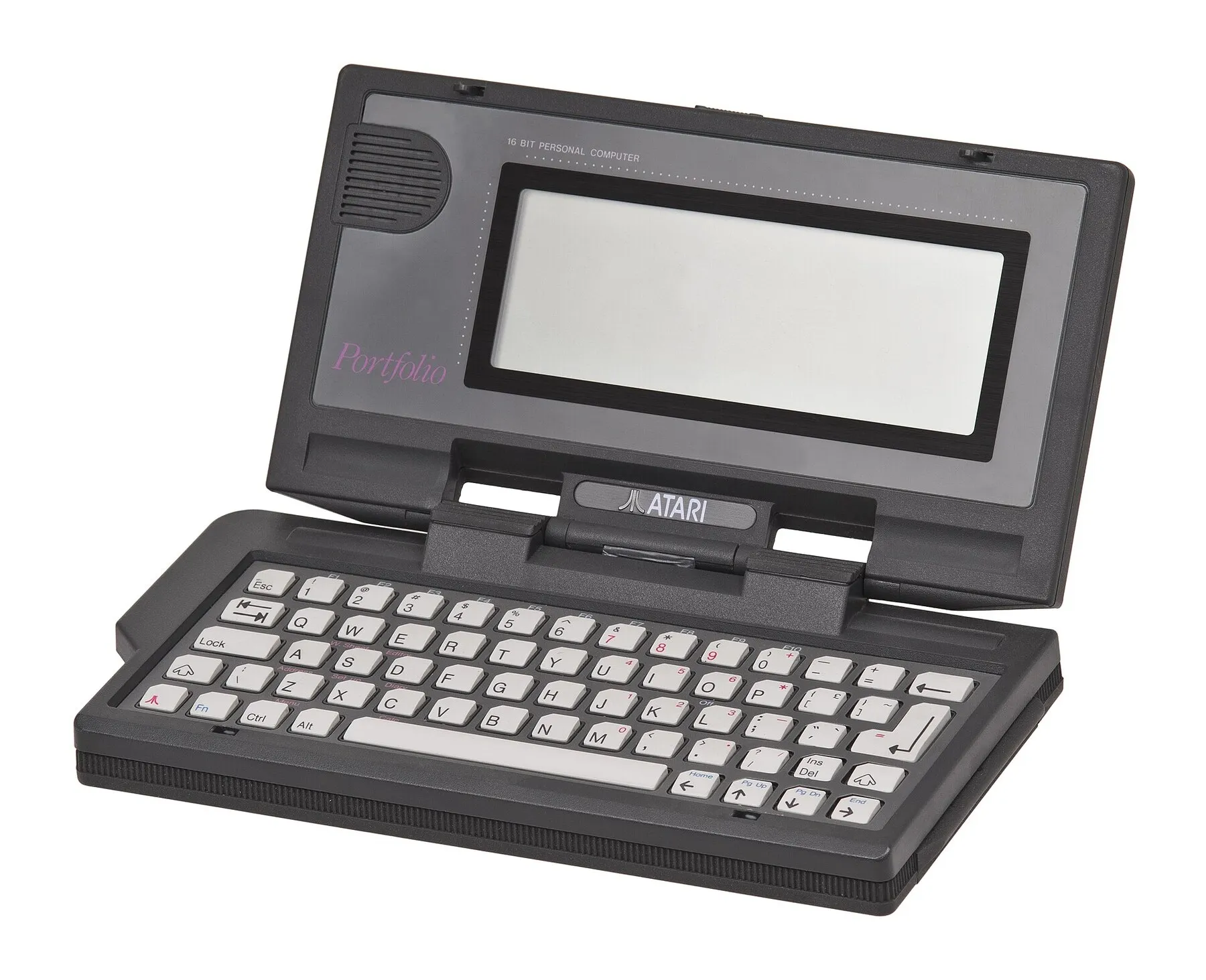
- Size: the Los Angeles Times described it as about one pound and the size of a VHS cassette, running on three AA batteries.
- Hardware: Atari’s technical reference guide gives an 80C88 processor at 4.9152 MHz and a 240 × 64 LCD showing 8 lines of 40 characters.
- Memory: 128 KB of RAM and 256 KB of ROM (START), with RAM expandable to 640 KB (Los Angeles Times) and a reader for credit-card-size memory cards.
- Software in ROM: an MS-DOS 2.11-compatible operating system, a text editor and a Lotus 1-2-3-compatible spreadsheet, with English, French and German menus, according to START.
Atari’s 1989 annual report claimed four to six weeks of use from a set of AA batteries. Z*Magazine reported that the Portfolio went on sale in 20 CompUSA stores on December 2, 1991.
Atari Transputer Workstation (ATW800)
Atari Corporation and the British company Perihelion presented a transputer workstation in London on September 22, 1987, according to atari-computermuseum.de; Ram Meenakshisundaram’s ATW800 pages instead date its first introduction to Fall COMDEX that November, under the name Abaq. InfoWorld described a machine built around Inmos’s 20 MHz T800 transputer, expandable to 13 processors working in parallel, that needed a 4 MB Mega ST as its input/output front end. It ran Helios, which Atari described as a Unix-like multiuser, multiprocessor operating system. Display options included 1280 × 960 in 16 colors. Atari promised it for the second quarter of 1988, at about US$5,000 for a 4 MB single-processor system.
It was sold as the ATW800, a tower that holds a modified Mega ST board as its I/O server, a main board with a T800 and 4 MB, and a video card, according to Ram Meenakshisundaram’s ATW800 pages. They report that Atari’s documents give either 50 prototypes in May 1988 and 300 production machines in May 1989, or 100 and 250: about 350 in all. A Perihelion price list dated September 1989 puts the ATW with 4 MB, a 40 MB hard disk, Helios and X Windows at £4,950.
Unreleased prototypes and concepts
The 1850XLD and the Amiga chips
According to the New York Times, Atari, Inc. had paid Amiga Corporation, a small Silicon Valley company, US$500,000 to develop three chips, and Atari Corporation, by then under Jack Tramiel, sued Amiga on August 13, 1984. The Digital Antiquarian dates the letter of intent to March 1984 and reports that Amiga repaid the money with interest on June 29, 1984, before Commodore bought it.
According to Atari engineer Steve Bristow, as reported by the Atari Museum, the planned 1850XLD was to use the Amiga “Lorraine” chip set with a 68000 processor and a detachable keyboard, for release in the first quarter of 1985. The museum also cites a 1650XLD from the engineering logbooks of Steve Bristow and Ken Warren, and says all of these XL projects were canceled after the sale of Atari’s consumer business on July 2, 1984.
1400XL and 1450XLD
At the Summer Consumer Electronics Show in June 1983, Atari, Inc. announced the 1400XL, with a built-in modem and speech synthesizer at a list price of US$500, and the 1450XLD, which added a built-in 5.25-inch disk drive, at US$800 (Creative Computing). Neither was sold. The 8-bit page covers them with the rest of the XL line, and the Sweet 16 page covers the 1982 project that led to the 1200XL.
Concept renderings
The archived Atari Historical Society concepts section showed renderings of desktop, modular and laptop concept designs made at Atari, Inc. in 1983.
Sources
- Computers at CES, Consumer Electronics, via Bally Alley, February 1979
- Atari 800 Turns 40, Vintage Computing and Gaming, 2019
- Three Years with the ST, START magazine, vol. 3 no. 1, Summer 1988
- Z*Magazine, issue 202, Z*Magazine, via AtariArchives.org, January 27, 1992
- Atari's New Computers, ANTIC, vol. 6 no. 1, May 1987
- Atari Floods Comdex With Products, InfoWorld, via Internet Archive, November 9, 1987
- Comdex: Messespektakel in Las Vegas, Wettlauf der Computergiganten, Happy Computer, February 1988
- Atari history 1987, Atari Computermuseum (atari-computermuseum.de)
- Atari Corporation Annual Report 1989, Atari Corporation, via Internet Archive, 1990
- Die Zugpferde: DTP und MIDI - Atari Pressekonferenz '90, TOS magazine, May 1990
- Atari-Messe, TOS magazine, October 1991
- The Traveling Computers, START magazine, vol. 4 no. 3, October 1989
- New Pocket PCs Are a Mixed Bag, Los Angeles Times, October 19, 1989
- Atari Portfolio Technical Reference Guide, edition 1, Atari Corporation, via Silicium, September 1989
- Ram's Totally Unofficial ATW800 Homepage, Ram Meenakshisundaram, transputer.classiccmp.org
- Atari ATW800 Price List (1989), atw800.complicated.net, September 1989
- Atari Head Sues Ally That Defected to Rival, The New York Times, August 21, 1984
- The 68000 Wars, Part 2: Jack Is Back!, The Digital Antiquarian, April 2015
- The Atari 1450XLD Computer Systems, Atari Museum
- Atari computers back on track, Creative Computing, vol. 9 no. 9, September 1983
- Atari concept designs (archived Atari Historical Society page), Internet Archive
Last reviewed October 30, 2026.
Related pages
- Atari 8-bit computer family
Atari's 6502 home computers, from the 400 and 800 of 1979 to the XE Game System of 1987, all built on ANTIC, CTIA or GTIA, and POKEY
- Atari ST family
Atari Corporation's 68000 and 68030 computers, from the 520ST of 1985 through the Mega ST, STE and TT030 to the Falcon030 of 1992
- Atari corporate history: from Atari, Inc. to Atari SA
Atari, Inc., Warner, the 1984 split, Atari Corporation, Atari Games, JTS, Hasbro Interactive, Infogrames and Atari SA, with dates and prices