Atari 2600 (Video Computer System)
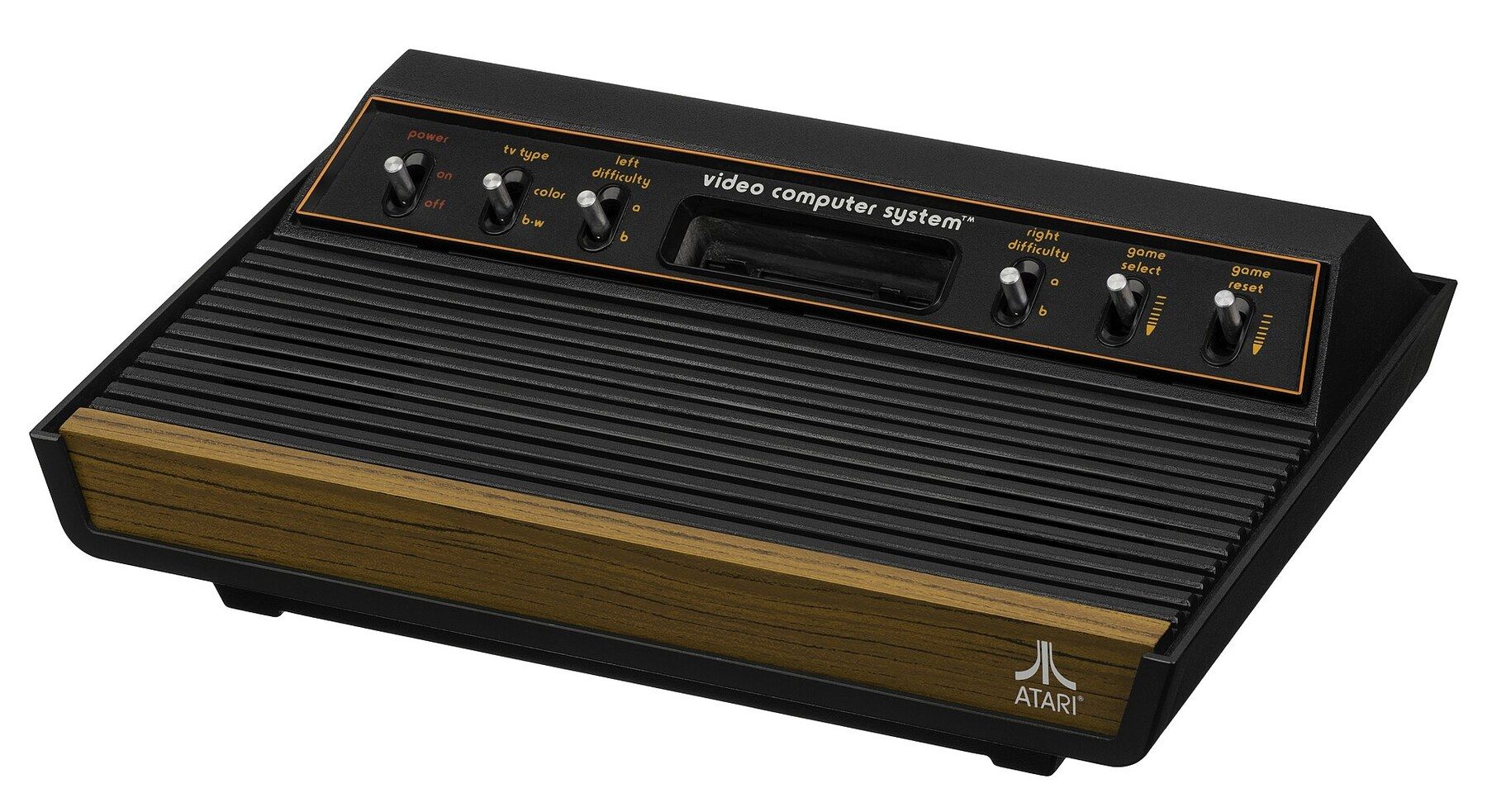
The Atari 2600 is the cartridge console that Atari, Inc. introduced in June 1977 as the Video Computer System, part number CX2600. It ran each game as a program on a cut-down 6502 processor with 128 bytes of RAM and a custom video chip, the TIA, so one console could play any game sold on a plug-in ROM cartridge. Atari, Inc. renamed it the Atari 2600 when the 5200 arrived in 1982, and Atari Corporation decided at the end of 1991 to stop selling it in the United States.
Stella, from Cyan Engineering to Los Gatos
The design started at Cyan Engineering, Atari, Inc.’s engineering consultancy in Grass Valley, California. Steve Mayer and Ron Milner had sketched a programmable game machine and were looking for a cheap processor when MOS Technology brought the 6502 to the Wescon show in September 1975. IEEE Spectrum reported in 1983 that Chuck Peddle was offering it at US$8 apiece; Joe Decuir, who joined Cyan in late 1975, later wrote that MOS quoted US$25 for samples and US$5 in volume. In a later slide presentation, Decuir summed up the credit: “Steve Mayer and Ron Milner invented the design.”
Two prototypes followed. Milner built a functional one to prove the idea, and Decuir a gate-level one that imitated the future chip. An archived Atari Historical Society page describes the first as a wire-wrapped board built around a JOLT 6502 kit, played with controllers taken from the Tank arcade game.
Decuir writes that Atari, Inc.’s officers approved the work in February 1976 and sent him to Los Gatos to work under Jay Miner, who headed the project and designed the production video chip; Miner gave Decuir the rest of the system, and Larry Wagner was hired to lead the game programmers. The project was code-named Stella. Spectrum uses the name for the video chip itself and says it came from its designer’s bicycle. Sources name the core team differently: Spectrum credits “Messrs. Mayer, Milner, Miner, and Decuir”, while Decuir credits the invention to Mayer and Milner and the chip to Miner.
Why Atari, Inc. sold itself to Warner
Atari, Inc. lacked the money to put Stella into production on its own. Warner Communications announced a contract to buy the company on September 7, 1976 and completed the purchase on October 1, 1976, for about US$12 million in cash and US$16 million in debentures (Current). Spectrum’s 1983 account says Warner paid its US$28 million “largely on the strength of expectations for the VCS.”
Launch in 1977
Atari, Inc. showed the Video Computer System at the Consumer Electronics Show in Chicago on June 5 to 8, 1977, with two joysticks, a pair of paddles and the Combat cartridge. Television Digest’s report on the show gave the price as US$190 and the availability as July; Current gives the list price as US$189.95. On August 1 Television Digest reported that Atari, Inc. had begun shipping its first units, and Longs Drug Stores advertised the console that day for US$169.88; Macy’s asked US$180 in September (Current). In October the same weekly put the Sears version at US$179, “$11 below Atari suggested list”, and quoted Atari, Inc.’s product manager Patrick Kearney: 90,000 consoles shipped in the past two and a half months.
Later accounts give other dates and another price. Wikipedia puts the arrival in stores at about September 1977 and the launch price at about US$199, and quotes Nick Montfort and Ian Bogost’s Racing the Beam as saying the console was not sold until October 1977. Spectrum said in 1983 that Atari, Inc. was late getting the console to retailers for Christmas 1977; in October 1977 Coleco’s president, Arnold Greenberg, already blamed part of that year’s game shortage on late deliveries by Atari (Television Digest). By 1981 Atari, Inc. was quoting a list price of US$199.95 (Current).
Decuir lists nine launch titles: Air-Sea Battle, Basic Math, Blackjack, Combat, Indy 500, Star Ship, Street Racer, Surround and Video Olympics. Combat came in the box; Kearney said in October 1977 that the first eight cartridges sold separately had begun shipping three weeks earlier.
What is inside
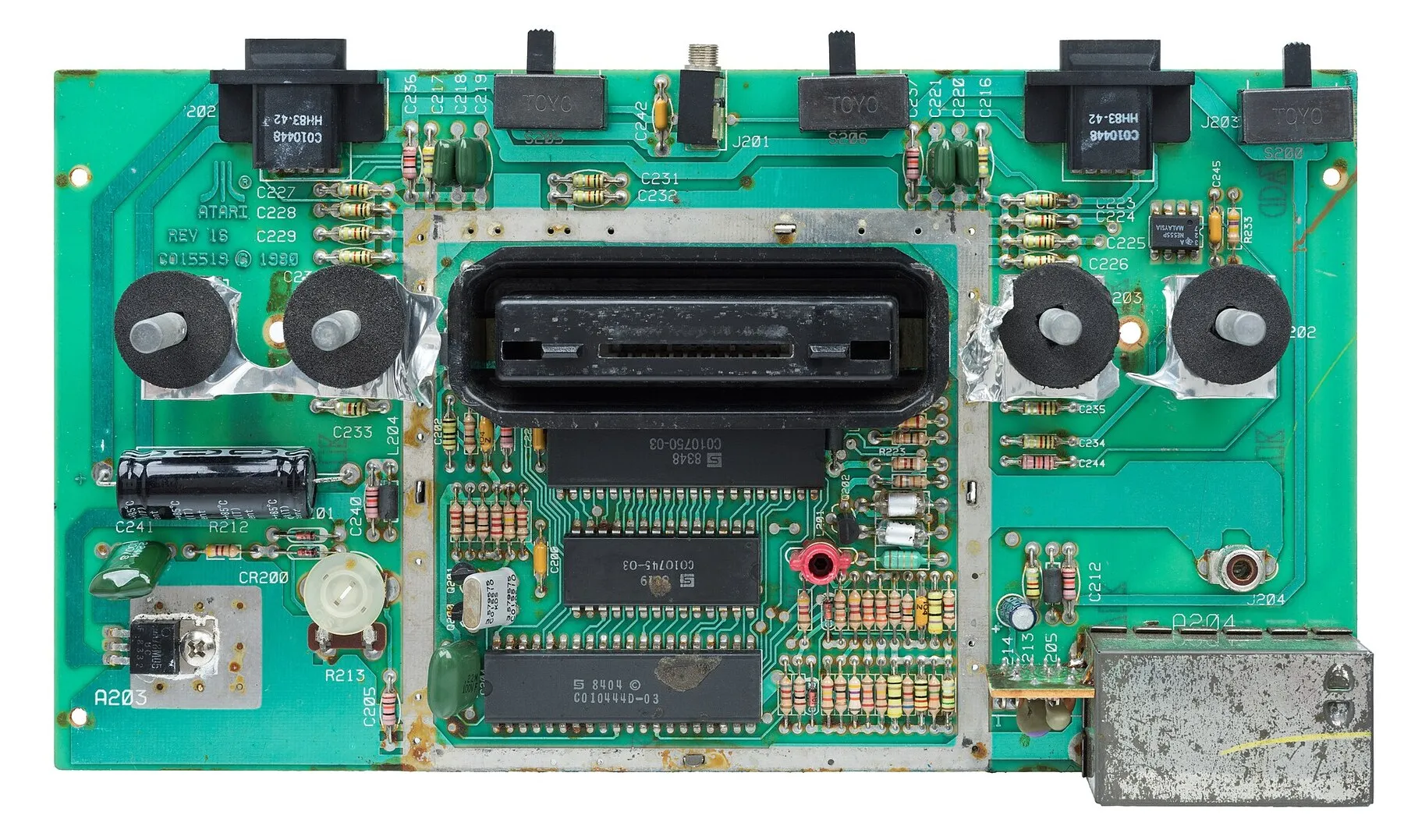
Everything rests on four chips:
- 6507. A 6502 in a 28-pin package with fewer address lines, which saved money but limited the console to 8 KB of address space.
- 6532 RIOT. 128 bytes of RAM, 16 I/O lines for the switches and joysticks, and a timer.
- TIA. Video, the two sound channels and the paddle and fire-button inputs.
- Cartridge ROM. 2 KB or 4 KB on the first games.
There is no frame buffer. The program has to feed the TIA new graphics data for each line as the TV beam moves, and there are no interrupts: instead, a “wait for sync” register in the TIA halts the processor until the next horizontal blank, as Decuir describes it. Spectrum reports that Miner and Decuir came to regret the 24-pin cartridge connector: a 30-pin one would have cost about 50 cents more per console and allowed RAM and a larger address space in cartridges.
Space Invaders and the sales curve
The first two years were hard. Spectrum reported that Atari, Inc. decided to build 800,000 consoles in 1978, had 500,000 orders by late summer, and was left with 300,000 unsold machines. Figures for 1977 differ: Decuir gives 250,000 units produced, while Warner’s annual report, as cited by Current, counts about 340,000 sold.
Atari, Inc. announced a license from Taito on January 28, 1980 for the home rights to Space Invaders, and the VCS cartridge was in stores by February or March 1980 (Current). Larry Kaplan, one of the first game programmers, told Spectrum: “The VCS was not doing that well… then Space Invaders came out, and bam! it exploded.” Alexander Smith’s history They Create Worlds, cited by Current, puts 1980 sales at more than one million consoles and 1.25 million Space Invaders cartridges.
By early 1983 Spectrum counted more than 12 million consoles sold at about US$140 each. Decuir’s 2015 total is more than 30 million shipped.
Models and revisions
| Model | Introduced | How to recognize it |
|---|---|---|
| CX2600 “heavy sixer” | 1977 | Six front switches, wood-grain front, thick plastic and shielding |
| CX2600 “light sixer” | 1978, made in Taiwan | Same layout in a thinner, lighter case |
| CX2600A four-switch | 1980 or 1981 (sources differ) | Difficulty switches moved to the back, capital-letter labels, still wood grain |
| 2600A all black (“Vader”) | 1982 or 1983 (sources differ) | Four-switch case without wood grain |
| 2600 Jr. | Europe from fall 1984; United States 1986 | Small flat case with a silver strip across the front |
The heavy and light sixer names come from collectors; Wikipedia, citing Goldberg and Vendel’s history of Atari, explains the difference as thinner plastic and shielding once production moved to Taiwan in 1978. The same year Atari, Inc. added a channel 2/3 switch and replaced the CX10 joystick with the CX40 (Current).
Current dates American production of the four-switch 2600A to 1981, Wikipedia to 1980. For the black model, Electronics for Kids reported in its January/February 1983 issue that Atari, Inc. would show a 2600 case “sleeker, and in black” at that month’s Winter CES, cut the suggested price to US$169.95 and pack Pac-Man with Combat; Wikipedia dates the black model and the 2600 name to November 1982, with the Atari 5200. Fans call the black model “Vader”. From the summer of 1983 American boxes no longer included paddles (Current).
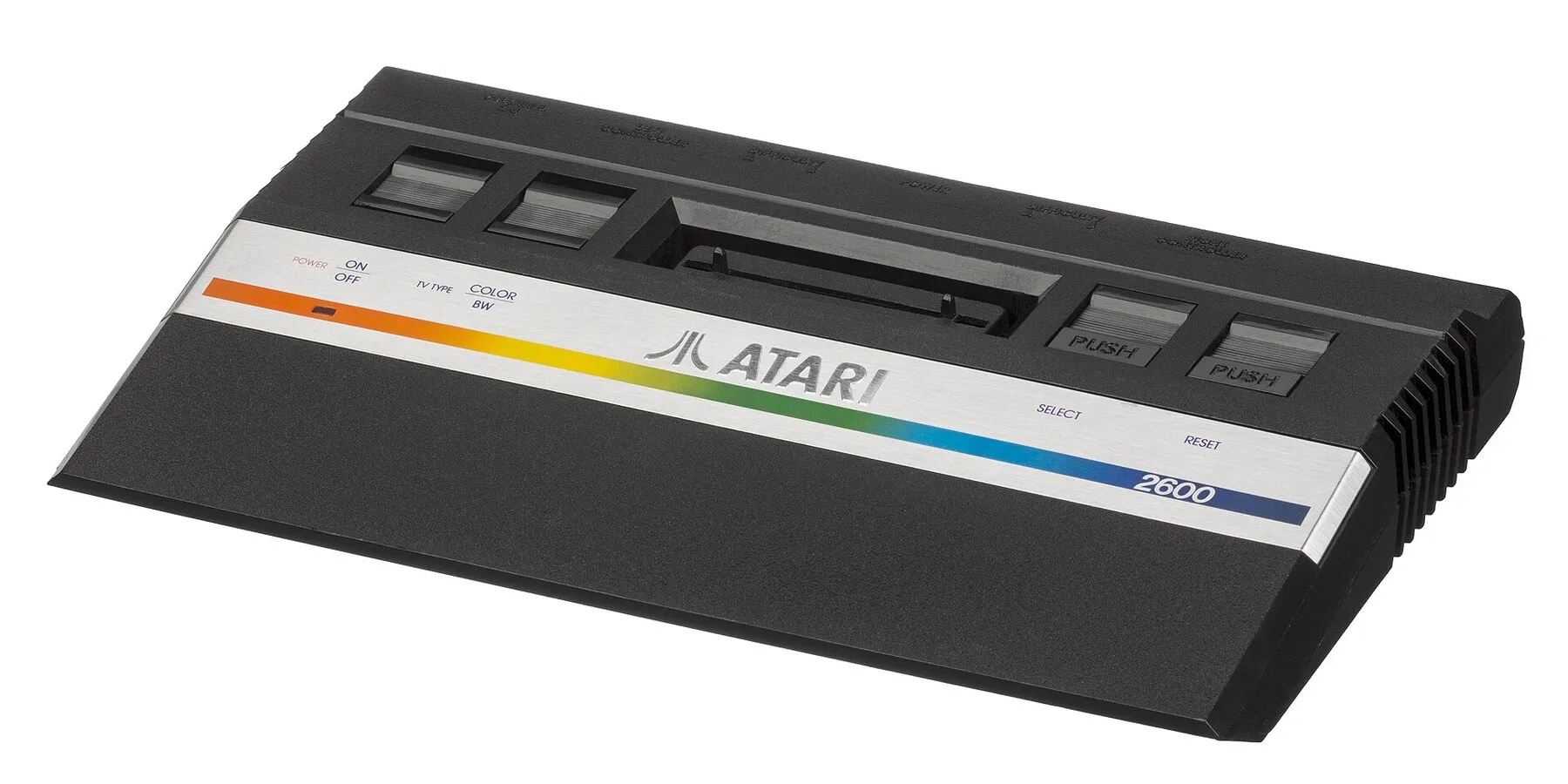
The 2600 Jr. began as the 2100, a cost-reduced 2600 that Atari, Inc. launched as a project in June 1983. Atari, Inc. showed a “2600jr” at CETEX in London in May 1984 at £74.99. After the Tramiel takeover, Atari Corporation used the 2100 case for new 2600 production from fall 1984 and introduced it in the United States at the January 1986 CES at US$49 with one joystick (Current).
Sears Tele-Games versions
Sears sold the console under its own Tele-Games brand as the Video Arcade. The Christmas 1977 Wish Book listed it at US$178.95 (catalog #99743) with Target Fun, the Sears name for Air-Sea Battle. Sears kept a six-switch model after Atari, Inc.’s own line moved to four switches, then switched to a four-switch version at US$149.99 in 1982.
The 1982 Wish Book added the Video Arcade II at US$189.99, an Atari, Inc. design known internally as “Cindy” that came with Space Invaders and two controllers combining a joystick and a paddle; it shipped in October 1982. Sears dropped both Video Arcade lines in the summer of 1983 (Current).
The 2700 and the 2800
The 2700 Remote Control Video Computer System, or “R.C. Stella”, was announced on January 5, 1981 and shown at that month’s Winter CES; Atari, Inc. confirmed at the January 1982 CES that it would not ship (Current). It had a wedge-shaped case and wireless controllers. The archived AHS page on the 2700 says that in testing the controllers reached about 1,000 feet and could interfere with other units, and that a fix was judged too costly.
The 2800 was the Video Arcade II design for Japan. Atari International (Nippon) announced it on April 12, 1983 at ¥24,800, for sale from May 10 with 25 titles and the CX28 joystick-and-paddle controllers (Current, citing the trade paper Game Machine). Wikipedia gives October 1983. The archived AHS page credits Joe Tilly with the electronics and says the case was later reworked for the Atari 7800.
Controllers and add-ons
Decuir lists four controller types designed and shipped by the original team. With later additions, the main ones were:
- CX10, then CX40 joystick. Bundled with every console; the CX40 replaced the CX10 in 1978.
- CX30 paddles. A pair of potentiometer controllers, bundled until the summer of 1983.
- CX20 driving controllers. Rotary controllers that turn without a stop, sold with Indy 500.
- CX50 keyboard controllers. Twelve-key pads announced in January 1978 and shipped late that year with Hunt & Score, Codebreaker and Brain Games.
- CX22 Trak-Ball. Shipped in the summer of 1983; a revised version with a true trackball mode followed in October 1983.
- CX23 Kid’s Controller. Sold from November 1983 for the first Sesame Street games.
Outside Atari, Inc., the Supercharger plugged into the cartridge slot, added 6 KB of RAM and loaded games from audio cassettes (Spectrum). Its maker was founded in June 1981 by Alan Bayley with two former Atari, Inc. engineers, Bob Brown and Craig Nelson, took the name Arcadia in 1982 and became Starpath in October 1982 (Current).
How the 2600 ended
The 2600 Connection, a newsletter for owners, reported in its March/April 1992 issue that “as of Christmas 1991” Atari Corporation had decided to discontinue the 2600 and 7800, that its entire inventory of games for both systems had been sold to Consolidated Stores (Odd Lots), and that, according to marketing vice president Dana Plotkin, the company would make no new hardware or software for either. The newsletter gave the reason as Atari Corporation’s focus on the Lynx.
The newsletter dates the decision to drop the line, not the last production run. Decuir wrote in 2015 that production ended in 1989, with the 2600 Jr.; Wikipedia, citing Montfort and Bogost, gives 1992. Current Notes reported that the 2600 and 7800 were still being sold at Atari Corporation’s shareholder meeting of June 2, 1992 (Current). The Atari consoles hub covers what came before the 2600 and the other machines Atari sold alongside it.
Sources
- Design case history: the Atari Video Computer System (republished as "Inventing the Atari 2600"), IEEE Spectrum (Tekla S. Perry and Paul Wallich), March 1983
- Champions in Our Midst: Game on! (Joe Decuir), IEEE Consumer Electronics Magazine, July 2015
- A History of Syzygy / Atari, Michael D. Current, compiled from period sources
- A History of WCI Games / Atari / Atari Games / Atari Holdings, Michael D. Current, compiled from period sources
- A History of Tramel Technology / Atari, Michael D. Current, compiled from period sources
- Atari Stories (presentation slides, Joe Decuir), Joe Decuir
- Television Digest, vol. 17 no. 24, Television Digest, via World Radio History, June 13, 1977
- Television Digest, vol. 17 no. 31, Television Digest, via World Radio History, August 1, 1977
- Television Digest, vol. 17 nos. 40 and 42, Television Digest, via World Radio History, October 3 and 17, 1977
- Atari Debuts a Host of Games, Electronics for Kids, January/February 1983
- News & Notes, The 2600 Connection, no. 9, March/April 1992
- Atari 2600 prototype (archived Atari Historical Society page), Internet Archive, captured February 2002
- Atari 2700 Remote Control VCS (archived Atari Historical Society page), Internet Archive, captured February 2002
- Atari 2800 (archived Atari Historical Society page), Internet Archive, captured June 2002
- Atari 2600, Wikipedia
Last reviewed October 30, 2026.
Related pages
- Atari consoles
Home Pong, the 2600, 5200, 7800 and Jaguar, the Lynx handheld, the XE Game System, and the consoles Atari announced but never shipped
- Atari 5200 SuperSystem
Atari, Inc.'s 1982 console built on the 400/800 chipset, with analog keypad controllers and 69 games, out of production by early 1984
- Atari 7800 ProSystem
Designed by General Computer Corporation, announced by Atari, Inc. in May 1984 and sold by Atari Corporation from 1986, with 2600 compatibility built in
- Atari and the video game crash of 1983
Warner's December 1982 warning, the cartridge glut, the Alamogordo burial and the July 1984 sale, with the documented figures kept apart from the legends
- Atari corporate history: from Atari, Inc. to Atari SA
Atari, Inc., Warner, the 1984 split, Atari Corporation, Atari Games, JTS, Hasbro Interactive, Infogrames and Atari SA, with dates and prices