Atari 7800 ProSystem
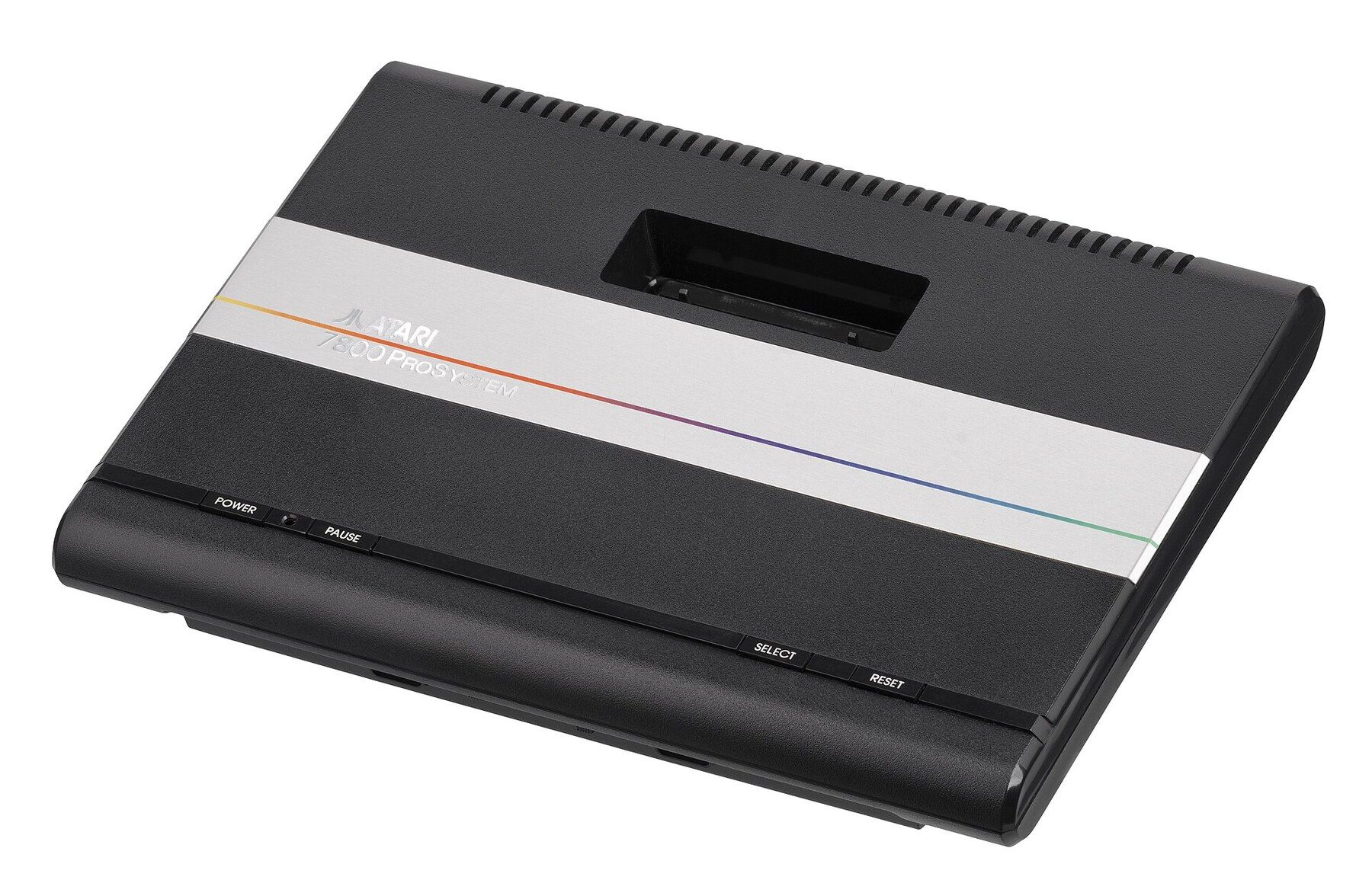
The Atari 7800 ProSystem is a cartridge console designed by General Computer Corporation (GCC) for Atari, Inc., which announced it in May 1984 as the successor to the Atari 2600 and Atari 5200. It pairs a new graphics chip, MARIA, with the 2600’s own chips, so it plays 2600 cartridges with no adapter. After Jack Tramiel bought Atari’s consumer business in July 1984, the finished consoles sat in storage. Atari Corporation put the 7800 on sale in the United States in 1986 at a suggested US$79.95, the year Nintendo took the Nintendo Entertainment System national.
Announced by Atari, Inc. in May 1984
Atari, Inc., then owned by Warner Communications, introduced the 7800 at a press event in New York on May 21, 1984. The New York Times gave the price as US$149 and the Washington Post as “approximately $150”. Atari said the console would reach retailers in July with at least 13 games and would run nearly 400 existing 2600 games. The Times also reported that the 5200 was no longer in production.
The 13 games, as listed by Michael Current, were 3-D Asteroids, Ballblazer, Centipede, Desert Falcon, Dig Dug, Food Fight, Galaga, Joust, Ms. Pac-Man, Pole Position II, Rescue on Fractalus!, Robotron: 2084 and Xevious. Three add-ons were announced with them: a computer keyboard for under US$100, a High Score Cartridge and an adapter to let the 5200 play 7800 games.
Inside Atari the project was first called the 3600: Current records an Atari Products Engineering design review of the “3600” on September 21, 1983, with development by GCC. Steve Golson, one of GCC’s engineers, lists what GCC delivered: the hardware, including MARIA; the launch games (fourteen by his count); the High Score Cartridge; new controllers; the keyboard and its software; and the cartridge authentication scheme. Curt Vendel’s Atari Museum credits MARIA to Art Ng, Golson and other GCC chip designers, and gives the part numbers GCC1701 for the first chip and GCC1702B for the production MARIA II.
Shelved after the Tramiel purchase
Warner sold Atari, Inc.’s consumer business to Jack Tramiel in July 1984, and press reports on the 7800 then went both ways: the Wall Street Journal and Business Week reported in July that Tramiel would not go ahead with it, AdWeek in August that Atari would introduce it for Christmas (Current). No national release followed. Computer Entertainer later wrote that the consoles had sat in a warehouse since mid-1984.
Whether any 7800 was sold in 1984 is disputed. AtariAge’s history mentions small test-market sales, and the archived Atari Historical Society page on the High Score Cartridge speaks of an “initial release” in June 1984. The Atari Archive’s research into release dates concludes that no units or games appear to have been sold that year.
GCC was left unpaid. Golson’s chronology for 1984: in July GCC negotiated with Tramiel, in late summer its video game work ended, and in October the company made major layoffs. According to Curt Vendel’s Atari Museum, Warner and the Tramiels disputed who owed GCC for MARIA and the console, Atari Corporation eventually paid GCC a US$3.2 million settlement, and a separate deal for about a dozen GCC games was signed in late 1985. No other source consulted gives the amount.
On sale in 1986
At the Winter Consumer Electronics Show in January 1986, Atari Corporation showed the 7800 again. Computer Entertainer reported in February that it would be available the next month at a suggested retail price of US$79.95, with controllers and a Pole Position II cartridge. March passed without stock. In June the newsletter printed a letter from a reader who had canceled his order, and added that it had no confirmation of any shipment, although one Atari executive said the console had shipped.
The July 1986 issue reported the 7800 on Toys “R” Us shelves from early June, starting in the Pacific Northwest, with Ms. Pac-Man, Joust and Deluxe Asteroids. An Atari spokesman blamed the delay on cartridges from Atari’s production facilities in Taiwan. Computer Entertainer’s year-end chart, published in February 1987, nevertheless gives May 1986 for the nationwide introduction.
Atari Corporation competed on price. HFD reported in June 1986 that the 7800 sold for under US$80 and the redesigned 2600 for under US$50, and quoted Michael Katz, president of Atari’s Entertainment Products division: “Our hardware is half the price of the competition.” The same article put the NES Deluxe package at US$139 to US$149 and the Sega Master System at a suggested US$150.
According to the year-end chart, eight games were available within 30 days of the launch, counting the Pole Position II pack-in, and ten by December. The two additions were Galaga, in early August, and Xevious, which Atari said in mid-November had shipped and would be its last 7800 release of the year (Computer Entertainer, December 1986). Asked how many consoles had been sold, an Atari spokesman said 100,000 had been made and sold in 1986, a figure that included the units built in 1984.
The MARIA chip and 2600 compatibility
The 7800 is a 2600 with additions. Its 2600 mode uses the TIA (Television Interface Adaptor) and the 6532 RAM-I/O-timer chip as the 2600 does. In 7800 mode, Atari’s 7800 Software Guide describes:
- SALLY, a 6502 with an added HALT line, running at 1.79 MHz;
- 4 KB of RAM in two 6116 chips;
- the TIA, kept for sound and the fire-button and paddle inputs;
- the 6532, kept for the joysticks and console switches;
- MARIA, which produces all of the video.
Any access to the TIA or the 6532 slows the processor to 1.19 MHz, because those chips are too slow for full-speed operation.
MARIA drops the players, missiles and playfield of the 2600 and 5200. The guide describes its method as the one “commonly used in coin-operated games”: the chip builds each scan line in a buffer called Line RAM from a list of objects, the display list, and reads the graphics data from cartridge ROM or RAM by direct memory access (DMA), suspending the 6502 while it does so. Two Line RAM buffers alternate, one being displayed while the next is filled, so the number of objects on a line is limited only by the time MARIA needs to load them. Each object takes its colors from one of eight palettes of three colors, and a color byte combines a 4-bit hue with a 4-bit luminance, for 256 values. The Washington Post reported Atari’s 1984 claim of up to 100 moving objects.
The cartridge slot is wider than the 2600’s. It carries all sixteen address lines, three more than the 2600 slot, and adds a read/write line, the phase 2 clock, the HALT line, an audio input and a composite video input. A protection circuit checks a cartridge for correctly encrypted data before enabling 7800 mode; a 2600 cartridge fails the check and runs in 2600 mode. Atari, Inc. had asked GCC for the scheme to avoid another flood of poorly made games, according to the Atari Museum.
The High Score Cartridge
The High Score Cartridge, announced in May 1984, was to keep high-score tables for 7800 games. According to the archived Atari Historical Society page, GCC designed it and handed it to Atari, Inc. for circuit board layout and case design, with Gary Rubio in charge of building, testing and cost-reducing it. It was canceled with the other 7800 peripherals after the July 1984 sale; Rubio later told Curt Vendel it had “never even made it to the breadboard stage”. In November 1999 Rubio gave Vendel the original ROM code and a GCC schematic, and Vendel built cartridges from them in 2000, numbered 006 to 120 according to the same page: new builds, not Atari products. The keyboard and the 5200 adapter were never released either (Current).
Against the NES, 1986 to 1991
Computer Entertainer’s year-end chart set those 100,000 consoles against 1.1 million for the NES and 125,000 for the Sega Master System, and 10 games available for the 7800 against 36 for the NES. In January 1987 Atari said it had sold out of both the 2600 and the 7800 in 1986, and promised licensed versions of computer games such as Karateka, Choplifter, Summer Games, Winter Games, Impossible Mission and Skyfox for the spring.
Atari Corporation took Nintendo’s licensing terms to court. Nintendo required developers to give it exclusive rights to their games for two years, which, Atari argued, kept popular games off its own systems. On January 31, 1989 Atari Corporation filed a US$250 million antitrust suit against Nintendo. On May 1, 1992 a jury found that none of Nintendo’s practices had harmed Atari, and Judge Fern Smith dismissed the case that month.
The 7800 library grew slowly. In January 1989 Atari said the games due that quarter would bring it to 29 “active” 7800 titles (Current). AtariUser wrote in July 1992 that Alien Brigade, Basketbrawl, Motor Psycho, Midnight Mutants, Planet Smashers and Ninja Golf had come out “only months ago”; Current dates them to late 1990 and 1991, and places the last US releases in 1991.
The same AtariUser article reported that “as of Christmas 1991” Atari had decided to discontinue the XE Game System, the 2600 and the 7800, and that much of the stock had gone to Consolidated Stores (which ran Odd Lots and Big Lots; The 2600 Connection had reported in March/April 1992 that the entire game inventory for both consoles had been sold to Consolidated Stores). Consoles were still on sale in mid-1992: at Atari Corporation’s shareholder meeting on June 2, 1992, the 2600 and 7800 were reported as still being sold (Current, citing Current Notes).
European models and documentation
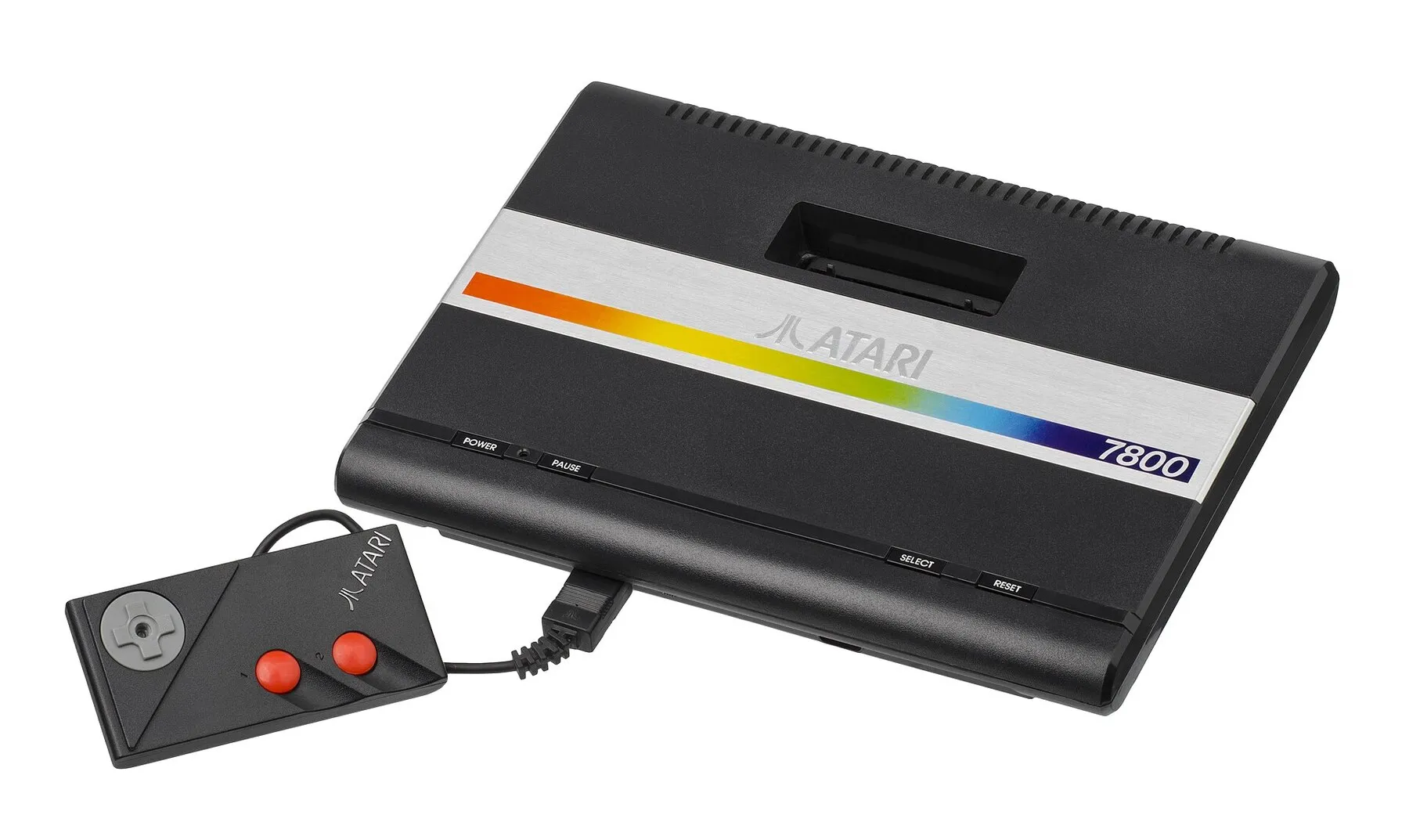
Atari showed a Joypad controller, the CX78, for the 7800 at the June 1988 Consumer Electronics Show, but the US package with it never shipped. In 1989 Atari Corporation began shipping PAL versions for Europe in a case with a thicker rainbow stripe, with Asteroids built in and two CX78 joypads in the box: PAL B for Europe (West Germany), PAL I for the United Kingdom (Current).
For programmers, the main document is Atari’s 7800 Software Guide, which covers MARIA, the display list format, the memory map and the graphics modes. Dan Boris’s transcription is linked in the sources.
Sources
- Atari Video Game Unit Introduced, The New York Times, May 22, 1984
- Atari Introduces Game In Attempt for Survival, The Washington Post, May 22, 1984
- 7800 Software Guide (transcribed by Dan Boris), Atari, Inc. / General Computer Corporation, via AtariHQ
- Lawyers, Games and Money: General Computer Goes to Court (talk slides), Steve Golson, California Extreme, July 27, 2024
- Computer Entertainer, vol. 4 no. 11, Computer Entertainer, February 1986
- Computer Entertainer, vol. 5 no. 3, Computer Entertainer, June 1986
- Computer Entertainer, vol. 5 no. 4, Computer Entertainer, July 1986
- Computer Entertainer, vol. 5 no. 9, Computer Entertainer, December 1986
- Computer Entertainer, vol. 5 no. 11, Computer Entertainer, February 1987
- Atari, Sega, and Nintendo Plan Comeback for Video Games (reprint), HFD/Weekly Home Furnishings, June 23, 1986
- Nintendo Is Sued by Atari, The New York Times, February 2, 1989
- Company News; Nintendo Suit by Atari Is Dismissed, The New York Times, May 16, 1992
- AtariUser, July 1992 (Tim Duarte, retrospective and buying guide for Atari game systems), AtariUser, July 1992
- A History of WCI Games / Atari / Atari Games / Atari Holdings, Michael Current
- A History of Tramel Technology / Atari, Michael Current
- The Atari 7800 High Score Cartridge (archived Atari Historical Society page), Internet Archive, captured February 2001
- The Atari 7800 ProSystem, The Atari Museum (Curt Vendel)
- Atari 7800 History, AtariAge
- Atari 7800 Game Release Dates, Atari Archive
Last reviewed October 30, 2026.
Related pages
- Atari 2600 (Video Computer System)
Atari, Inc.'s cartridge console of 1977: a 6507 processor, 128 bytes of RAM and the TIA video chip, dropped in the United States at the end of 1991
- Atari 5200 SuperSystem
Atari, Inc.'s 1982 console built on the 400/800 chipset, with analog keypad controllers and 69 games, out of production by early 1984
- Atari Jaguar
Atari Corporation's cartridge console with Tom and Jerry chips by Flare II, sold as 64-bit from November 1993, with production orders stopped in mid-1995
- Atari corporate history: from Atari, Inc. to Atari SA
Atari, Inc., Warner, the 1984 split, Atari Corporation, Atari Games, JTS, Hasbro Interactive, Infogrames and Atari SA, with dates and prices
- Atari and the video game crash of 1983
Warner's December 1982 warning, the cartridge glut, the Alamogordo burial and the July 1984 sale, with the documented figures kept apart from the legends