Atari Jaguar
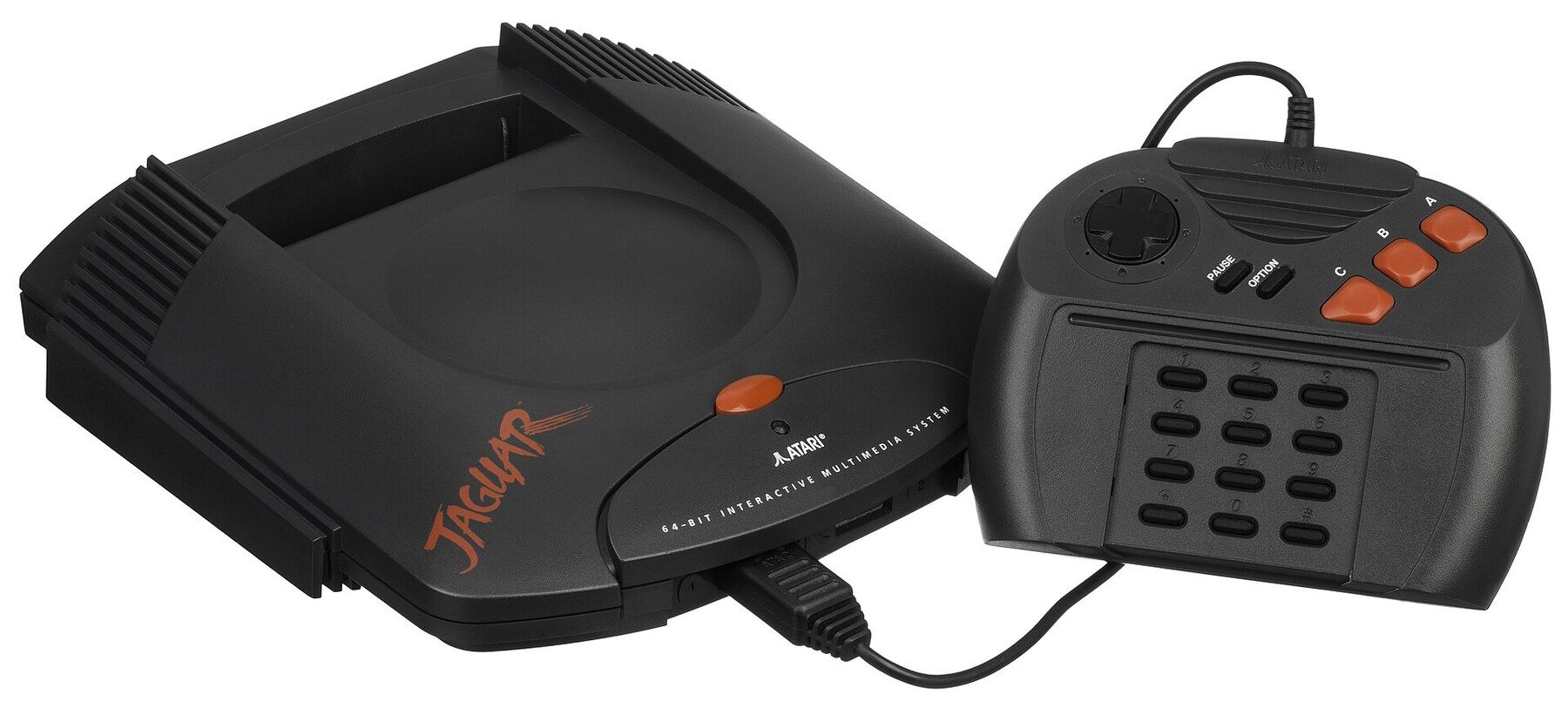
The Atari Jaguar is a cartridge console that Atari Corporation launched in New York and San Francisco in November 1993, at US$249.99 with the game Cybermorph, and rolled out across the United States in 1994. Its two custom chips, Tom and Jerry, were designed by Flare II, a British company 80% owned by Atari, and Atari sold it as the first 64-bit game system. Atari placed no console manufacturing orders after mid-1995 and had sold about 125,000 units by the end of that year; in 1996 Atari Corporation merged with the disk drive maker JTS.
From Panther to Jaguar: the Flare II design
John Mathieson, who designed much of the chipset, gave the background in a January 1995 interview with Atari Explorer Online. After Sinclair Research folded in 1986, he, Martin Brennan and Ben Cheese founded Flare. Their first system, Flare One, was licensed for the Konix Multi System, which never reached the market. Brennan was working for Atari on the Panther console as a consultant in late 1989 when Flare presented its next design to Atari, and Atari took 80% of a new company, Flare 2, to build it. Michael Current’s timeline dates it to 1990: Arcbase Limited, formed on May 3, became Flare II Limited on June 1.
Brennan designed the video system, loosely based on Panther, and the memory controller; Mathieson designed the RISC processors and the Blitter. Mathieson put the work at three years from start to production-ready, and believed Panther was dropped because the Jaguar would have followed it by only one or two years. The chip names meant nothing: “The names were arbitrary,” he said, for what was simply a video chip and an audio chip.
Atari’s own statements present the chips as in-house work. EE Times reported in July 1993, citing Sam Tramiel, that they were designed “at an Atari facility in England”, and Atari’s 1994 annual report to the SEC says they were developed “in the Company’s own facilities”. According to the same EE Times article, Tramiel said Atari had built a 16-bit prototype two years earlier and scrapped it. Sources also differ on who made the chips: the 10-K for 1994 names Motorola, while Robert Jung’s Jaguar FAQ of December 1994 names Toshiba and Motorola.
Announcement, IBM and the 1993 launch
Atari Corporation announced the Jaguar on June 3, 1993, with a fall launch in the New York market, a national rollout within a year and a price of about US$200. On June 28 it said IBM’s plant in Charlotte, North Carolina, would build the console under a multiyear contract valued at US$500 million; EE Times described it as a 30-month contract. IBM was to handle component sourcing, quality testing, assembly, packaging and distribution; the circuit boards came from a subcontractor (EE Times, Jung’s FAQ).
Atari showed working consoles to the press at its Sunnyvale headquarters on August 18, 1993, where Sam Tramiel announced plans to distribute 50,000 units in New York and San Francisco that year and to sell more than 500,000 in 1994. The 10-K for 1994 dates the launch in those two markets to late November 1993, at a suggested price of US$249.99, and says Atari shipped about 17,000 consoles in the fourth quarter; Atari’s own figure in January 1994, reported by Consumer Electronics and cited by Current, was 20,000 sold.
The first games after Cybermorph were Raiden, Evolution: Dino Dudes and Trevor McFur in the Crescent Galaxy. In January 1994 Atari announced a nationwide rollout for the first half of the year, and the 10-K records the rollout and the first shipments to Europe during 1994. In Japan, the distributor Mumin released the Jaguar on December 9, 1994 at ¥29,800 (Current). About 100,000 units had been sold by the end of 1994 (10-K).
Assembly later passed from IBM to another contractor. In an Atari press release of June 23, 1994, Sam Tramiel still said the Jaguar was “manufactured by IBM in the U.S.”; the 10-K filed in March 1995 states that the console was “currently being assembled by Comptronix in the U.S.A.” None of the sources consulted dates the change.
Tom, Jerry and the 64-bit question
The Jaguar has five processors in three chips (Jung’s FAQ). Tom holds a graphics processor (GPU), the Object Processor that assembles the display, the Blitter that draws and fills, and the DRAM controller. Jerry holds a digital signal processor (DSP) for sound, the audio output, timers and the joystick interface. The third chip is an ordinary Motorola 68000. The GPU and the DSP share the same RISC (reduced instruction set) core and run code from small fast memories of their own, 4 KB and 8 KB, as well as from main memory.
Atari marketed the whole system as 64-bit. Its June 1993 announcement described “an Atari-designed proprietary 64-bit RISC processor”, and in August Sam Tramiel said “the system’s 64-bits are true 64-bits”. Jung’s FAQ gives a more mixed picture: the GPU is a 32-bit RISC design with access to the full 64-bit bus, the DSP is 32-bit, and the 68000 can use only 16 bits of the bus at a time.
Mathieson’s answer in 1995 was that the memory interface, the Object Processor and the Blitter are 64-bit because moving data is where a game console needs width, while 3D calculations and audio gain nothing from 64-bit numbers. The Jaguar, he said, “can reasonably be considered a 64-bit system. But that doesn’t mean it has to be 64-bit throughout.” Atari had wanted a 68000-family processor, and Mathieson thought developers needed a conventional CPU to start with, but he maintained that it was “only there to read the joysticks”.
The controller and its keypad
The standard controller has an eight-way joypad, three fire buttons labeled A, B and C, Pause and Option buttons, and a 12-key keypad that accepts game-specific overlays (Jung’s FAQ). The 10-K for 1994 also lists a six-button controller among the accessories.
Games and delays
Tempest 2000 shipped in April 1994 at US$59.99. Alien vs. Predator reached stores on October 21, 1994 at US$69.99. On December 2, 1994 Atari announced Doom as available; id Software had done the conversion itself, and two players could play on two linked consoles.
At its June 1994 shareholder meeting Atari had promised 30 to 50 titles by Thanksgiving. The 10-K for 1994 instead reports “substantial delays” in releasing software, which Atari attributed to the time it took its own staff and outside developers to learn the hardware. In March 1995 Atari was marketing about 17 titles of its own, with outside publishers selling 8 more. By April 1996 Atari had published about 45 Jaguar titles and knew of no current development by outside publishers.
The 1994 Sega agreement
On October 19, 1993 Atari Corporation sued Sega of America for infringing US patent 4,445,114, an “apparatus for scrolling a video display” patented in April 1984 (Current). The case ended with an agreement announced on September 28, 1994 in a joint press release issued from Sunnyvale by Sega Enterprises, Ltd. and Atari Corporation. The release set out these terms:

- Sega and its subsidiaries, licensees and customers receive worldwide, non-exclusive rights, with certain exceptions, to Atari’s patent library, more than 70 US patents and patent applications, “a number of which extend beyond the turn of the century”.
- Sega pays a fully prepaid royalty for the remaining seven years of certain patents, amortized at about US$7 million a year, for a total of US$50 million less Atari’s contingent attorney fees and costs.
- Sega buys about 4.7 million shares of Atari common stock for US$40 million.
- The two companies enter into software license agreements for a specified number of games, for their present and future platforms.
- Atari dismisses its legal proceedings against Sega, and each company releases all claims against the other.
- The agreements are subject to approval by the US Department of Justice and the Federal Trade Commission under the Hart-Scott-Rodino Act, and to certain other conditions.
The release quotes David Rosen, co-chairman of Sega of America, on a relationship “that has potential long-term benefits for both companies”. Sam Tramiel, president and chief executive of Atari Corporation, said the increased cash position would be used “among other things to enhance our marketing position this fall”.
The same day, Garry Tramiel, Atari Corporation’s general manager, sent a letter to dealer customers with a copy of the release, which had gone out on the Business Wire. He wrote that Atari would have additional resources to market the Jaguar, with a marketing program for the fourth quarter of 1994, and promised about thirty Jaguar titles by Christmas. Among the fourth-quarter releases he named Atari’s Alien Vs. Predator, Kasumi Ninja, Doom and Iron Soldier, and third-party games from Williams (Troy Aikman Football, Double Dragon V), Ubi Soft (Rayman) and Ocean (Theme Park, Syndicate, Soccer Kid).

Atari’s SEC filings give the final figures. The agreements were signed on September 26, 1994. Sega paid US$8.50 a share for 4,705,883 shares, US$40.0 million in all, and held about 7.4% of Atari. Of the US$50.0 million royalty, Atari kept US$29.8 million after US$20.2 million in legal fees and costs. The license covers Atari patents issued from 1977 through 1984, excluding patents that only claim elements of the Jaguar and the Lynx, and runs through 2001, as does a cross-license of up to five games a year. Computer Business Review and Mathieson both put the deal at US$90 million, the sum of the US$50 million royalty before fees and the US$40 million share purchase. Atari announced on November 16, 1994 that regulatory approval had been received and the transactions had closed.
The holiday list in the letter only partly held:
| Title | What happened |
|---|---|
| Alien Vs. Predator | In stores October 21, 1994 |
| Doom | Announced as available December 2, 1994 |
| Iron Soldier, Kasumi Ninja | Listed for early December on December 9, 1994; releases announced December 22, 1994 (Kasumi Ninja per Current) |
| Troy Aikman Football, Double Dragon V, Theme Park, Syndicate | Listed on December 9, 1994 for the first quarter of 1995, and again in February 1995 |
| Rayman | Listed on December 9, 1994 for early 1995; release announced in September 1995 (Current) |
| Soccer Kid | Not found in Atari’s later announcements or in Current’s timeline |
Price cuts, the Jaguar CD and the end of production
In the first quarter of 1995 Atari cut the wholesale price so that stores could sell the console for US$149.99 to US$159.99, and in March it announced a “64-Bit Power Kit” for under US$160: console, controller, power adapter and video cable, with no game. Atari’s 10-K for 1995 attributes the Jaguar’s poor performance to factors including the long delays in Jaguar software and the competing consoles that Sega and Sony launched in May and September 1995.
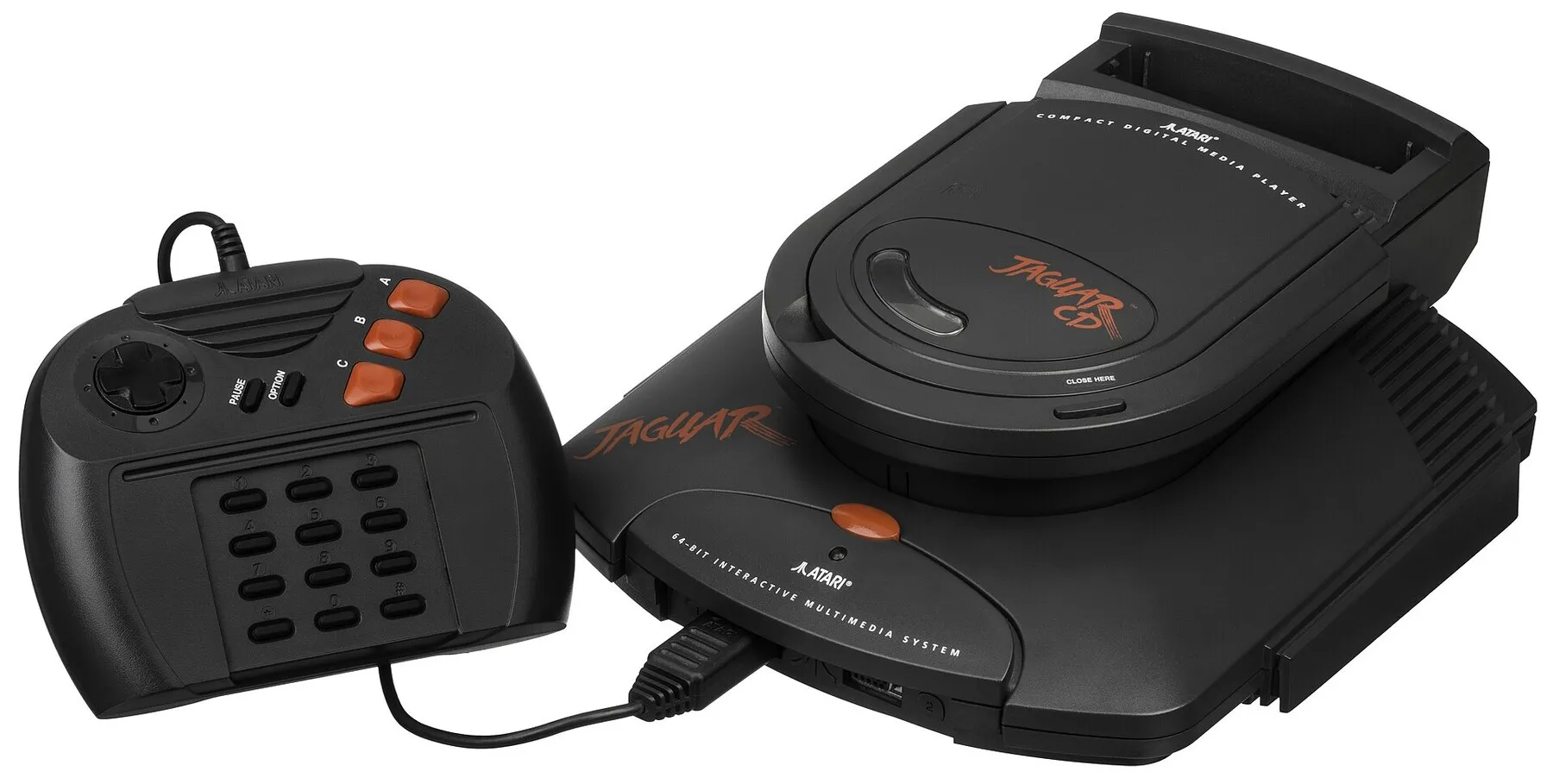
The Jaguar CD, a double-speed drive that plugs into the cartridge slot, was announced in June 1994 for Christmas at US$199.95, then planned for the second quarter of 1995 at US$149.99. Atari announced it in stores on September 21, 1995 at US$149.95 (the 10-K for 1995 gives US$149.99), with the Virtual Light Machine, a light show that follows audio CDs, built in. The box included Blue Lightning, Vid Grid, a demo of Myst and the Tempest 2000 soundtrack on audio CD. On December 15, 1995 Atari cut the console to US$99 (US$99.99 in the 10-K).
The 10-K for 1995, filed in April 1996, records the result. Jaguar products brought in US$29.3 million in 1994 and US$9.9 million in 1995. Atari had sold about 125,000 consoles from launch through 1995 and still held about 100,000 in inventory. It had placed no manufacturing orders for the console since mid-1995, did not intend to make more, and had decided in late 1995 to downsize the Jaguar business significantly. A Multimedia Wire report of February 13, 1996, kept in the same archive as Atari’s press releases, gave a higher installed base of 150,000.
After Atari Corporation: JTS, Hasbro and the 1999 release
Atari Corporation and JTS Corporation agreed to merge on February 13, 1996. The merger was completed on July 30, 1996: Atari was merged into JTS, and about 63,850,000 JTS shares were issued to Atari’s stockholders, according to JTS’s filing with the SEC.
On February 23, 1998 JTS sold substantially all of the assets of its Atari Division to HIACXI, Corp., a subsidiary of Hasbro Interactive, for US$5 million in cash (JTS 8-K; the New York Times gave the same amount). Hasbro’s own 1999 statement dates the acquisition to March 1998.
On May 14, 1999 Hasbro Interactive announced that it had released “all rights that it may have” to the Jaguar platform, so that developers could publish Jaguar software without a license from it, provided they did not use the Atari trademark or logo or present their games as authorized or approved by Hasbro Interactive. The statement said nothing about patents.
Midsummer and the Jaguar VR, never released
Atari’s 10-K for 1994 describes a second-generation Jaguar in development, meant to play existing Jaguar games. Mathieson, by then Atari’s vice president of advanced technology, said in January 1995 that it was his main responsibility, with better polygon, texture-mapping and audio performance as its aims. Its technical reference manual calls the project Midsummer: two new chips, Oberon and Puck, replace Tom and Jerry, and the development boards shipping in August 1995 paired an Oberon test chip with a Jerry. The 10-K for 1995 reports that Atari had significantly downsized its research and development.
Atari and Virtuality signed an agreement in October 1994 for a virtual reality headset for the Jaguar, then targeted for Christmas 1995 at less than US$200. At the Electronic Entertainment Expo in Los Angeles in May 1995 they showed it as the Jaguar VR, with a targeted retail price of US$300 (Atari press release of May 16, 1995). It never shipped (Current).
For programmers, the Tom and Jerry Technical Reference Manual by Brennan, Dunn and Mathieson documents the chipset, and Jung’s FAQ collects the specifications and accessories as they were known at the end of 1994; both are linked in the sources.
Sources
- Atari Corp. Press Releases: Jaguar 1993-1997 (collected on justclaws.atari.org), Atari Corporation, via Internet Archive, June 1993 to January 1997
- Company News; I.B.M. to Manufacture New Atari Entertainment System, The New York Times, June 29, 1993
- Atari Jaguar an IBM animal (EE Times article by Junko Yoshida, archived Atari Historical Society page), Electronic Engineering Times, via Internet Archive, July 5, 1993
- Atari Jaguar Frequently Asked Questions (Robert Jung), Cleveland Free-Net archive, via Atarimax, December 31, 1994
- Interview with John Mathieson, Atari Explorer Online, vol. 4 no. 1, Atari Explorer Online, via atariarchives.org, January 16, 1995
- Technical Reference Manual, Tom & Jerry, Revision 8 (Martin Brennan, Tim Dunn, John Mathieson), Atari Corporation, via jag-docs, © 1992–1993; revision dated February 28, 2001
- Midsummer Technical Reference Manual, Revision 6, Atari Corporation, via jag-docs, © 1992–1995
- Sega and Atari Announce Long-Term Licensing Agreements, Equity Investment, and Resolution of Disputes (joint press release, scan), Atari Corporation, September 28, 1994
- Letter from Garry Tramiel, General Manager, to dealer customers (scan), Atari Corporation, September 28, 1994
- Atari, Sega End Their Feuding, Join Joysticks, The Washington Post, September 29, 1994
- Atari Gets $90m in Royalties, Equity in Settlement with Sega, Computer Business Review (Tech Monitor), September 29, 1994
- Atari Corporation, Form 10-Q for the quarter ended September 30, 1994, U.S. Securities and Exchange Commission, November 15, 1994
- Atari Corporation, Form 10-K for 1994, U.S. Securities and Exchange Commission, March 31, 1995
- Atari Corporation, Form 10-K405 for 1995, U.S. Securities and Exchange Commission, April 12, 1996
- JTS Corporation, Form 8-K (completion of the Atari merger), U.S. Securities and Exchange Commission, August 14, 1996
- JTS Corporation, Form 8-K (sale of the Atari Division to HIACXI, Corp.), U.S. Securities and Exchange Commission, March 9, 1998
- Company Briefs, The New York Times, March 17, 1998
- Hasbro Releases Publishing Rights to the Atari Jaguar 64 Platform (archived Atari Historical Society page), Internet Archive, May 14, 1999
- A History of Tramel Technology / Atari, Michael Current


Last reviewed October 30, 2026.
Related pages
- Atari consoles
Home Pong, the 2600, 5200, 7800 and Jaguar, the Lynx handheld, the XE Game System, and the consoles Atari announced but never shipped
- Atari 7800 ProSystem
Designed by General Computer Corporation, announced by Atari, Inc. in May 1984 and sold by Atari Corporation from 1986, with 2600 compatibility built in
- Atari ST family
Atari Corporation's 68000 and 68030 computers, from the 520ST of 1985 through the Mega ST, STE and TT030 to the Falcon030 of 1992
- Atari corporate history: from Atari, Inc. to Atari SA
Atari, Inc., Warner, the 1984 split, Atari Corporation, Atari Games, JTS, Hasbro Interactive, Infogrames and Atari SA, with dates and prices
- Atari technical documentation
Chip by chip and manual by manual, the documents that explain how Atari machines work, from the 1979 Stella guide to the Jaguar reference