Atari arcade games
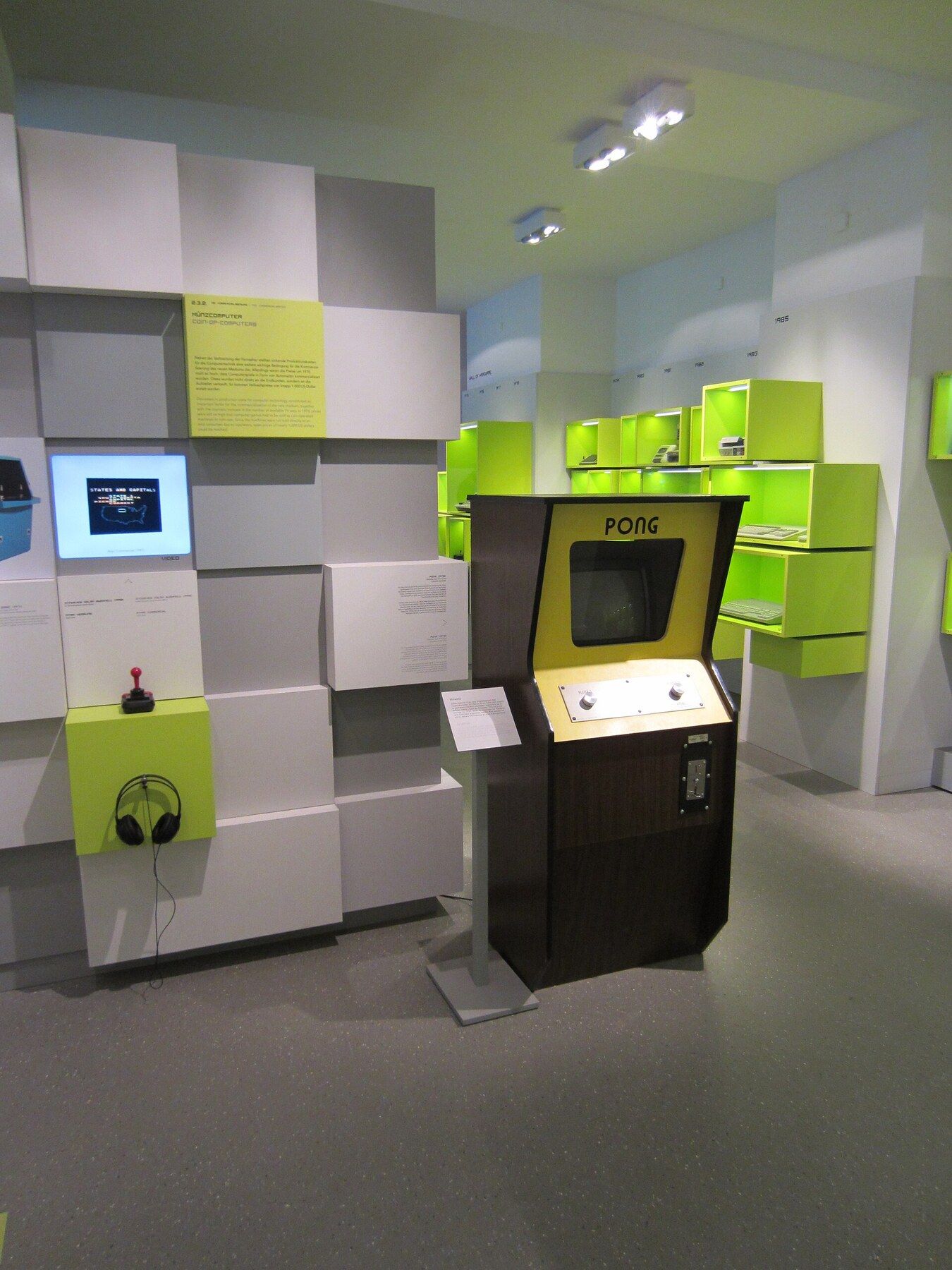
Atari’s coin-op division released Pong in 1972 and was still making arcade games, as Atari Games, at the end of the 1990s. The table below lists the main Atari cabinets from 1972 to 1989 in order of release, with the display each one used and what it introduced. The history of the company behind them, from Kee Games to Namco, Time Warner and Midway, is told in a history of Atari’s arcade division.
The main Atari cabinets, 1972 to 1989
Years are those given by the sources listed below; Atari, Inc. made the games until 1984, and Atari Games from 1985.
| Game | Year | Display | What it introduced or was used for |
|---|---|---|---|
| Pong | 1972 | Raster, black and white | The first product sold under the Atari name: table tennis for two players |
| Space Race | 1973 | Raster, black and white | Atari’s second coin-op, a race through meteors for one player against the clock or two head to head |
| Gotcha | 1973 | Raster, black and white | A maze chase, played with domed joysticks |
| Gran Trak 10 | 1974 | Raster, black and white | A driving game with steering wheel, gear shift and pedals, engineered at Cyan Engineering in Grass Valley |
| Tank | 1974 | Raster, black and white | A two-player tank battle, sold under the Kee Games name |
| Indy 800 | 1975 | Raster, color | A Kee Games race for eight players around one large cabinet |
| Breakout | 1976 | Raster, black and white | Billed as “the ultimate in Pong” on the archived AHS page |
| Night Driver | 1976 | Raster, black and white | First-person driving at night, with a sit-down version |
| Sprint 2 | 1976 | Raster, black and white | Called Atari’s first mass-produced microprocessor-based game on the archived AHS page |
| Atari Football | 1978 | Raster, black and white | Atari’s first game with a trak-ball |
| Lunar Lander | 1979 | Vector, black and white | Atari’s first vector game, on the Digital Vector Generator |
| Asteroids | 1979 | Vector, black and white | Developed on Lunar Lander hardware; 70,000 sold by late 1981, according to a federal court opinion |
| Missile Command | 1980 | Raster, color | Missile defense aimed with a trak-ball |
| Battlezone | 1980 | Vector, black and white | A first-person 3D tank game on the Analog Vector Generator and Math Box, later adapted for the US Army |
| Centipede | 1981 | Raster, color | Co-designed by Ed Logg and Dona Bailey; used the smaller 2.5-inch trak-ball |
| Tempest | 1981 | Vector, color | The first game on Atari’s Color QuadraScan monitor |
| Pole Position | 1982 | Raster, color | A Japanese racing game that, according to Warner, was helping to turn the coin-op division around at the end of 1982 |
| Star Wars | 1983 | Vector, color | A flight yoke derived from the Army Battlezone controller, in upright and cockpit cabinets |
| Marble Madness | 1984–85 | Raster, color | The first System I game, with two trak-balls and stereo music |
| Paperboy | 1985 | Raster, color, high resolution | The first System II game, steered with a bicycle handlebar |
| Gauntlet | 1985 | Raster, color | Four players at once, with one coin mechanism per player |
| Hard Drivin’ | 1989 | Raster, color, 3D polygons | A sit-down driving cockpit, with polygon graphics drawn by a TMS34010 graphics processor |
The Atari Compendium dates Marble Madness to 1984, while Atari Games presented it to operators as a new System I game in its spring 1985 newsletter.
Vector monitors: from black and white to Color QuadraScan
Atari called its X-Y monitor QuadraScan. Instead of scanning the whole screen line by line like a television, the beam draws each line of the picture directly. Atari’s vector hardware went through three stages, as described by Jed Margolin, an engineer who worked on several of these games:
- Digital Vector Generator. Designed by Howard Delman for Lunar Lander and used again for Asteroids and Asteroids Deluxe. Delman said the vector concept came from Atari’s research group in Grass Valley.
- Analog Vector Generator. First used in Battlezone and Red Baron, with a “Math Box” built around AMD 2901 bit-slice chips to do the 3D arithmetic.
- Color. An Atari document of September 24, 1981 describes how the black-and-white QuadraScan was redesigned around an in-line color tube with three Z amplifiers. Tempest came out on it in October 1981. Margolin notes that the Wells-Gardner color monitor had no pincushion correction, so that circuit was put on the Tempest board.
Space Duel (February 1982) kept the pincushion correction circuitry, and Star Wars (1983) also drove a color monitor. Margolin lists Major Havoc (November 1983) and The Empire Strikes Back (March 1985, a conversion kit for Star Wars) as the last X-Y games produced.
The trak-ball
Atari Football, released in October 1978, was Atari’s first game with a trak-ball; Taito and Sega had sold trackball games before it, according to the Atari Compendium. The 4.5-inch Trak-Ball, designed by Jerry Lichac, was also used in Basketball, Baseball, Soccer and Missile Command. A smaller 2.5-inch version went into the cocktail and cabaret Missile Command and then into every Centipede cabinet; a black version followed in 1982 in Millipede, Liberator and Quantum. Crystal Castles was the last trak-ball game before the 1984 split. Atari Games used a pair of them, one blue and one red, on Marble Madness, and its last trak-ball game was Shuuz in 1990.
Seats and cockpits
Several Atari games put the player in a seat:
- Hi-Way and Night Driver. The archived AHS page calls Night Driver (1976) Atari’s second sit-down game, after Hi-Way.
- Red Baron and Star Wars. Both had cockpit versions. The production list transcribed by Scott Evans gives 504 Red Baron cockpits and 2,450 Star Wars cockpits.
- Hard Drivin’. Michael Current’s timeline of Atari Games dates the deluxe cockpit version to February 1989 and a compact upright to June 1989.
System I and System II
The spring 1985 issue of Atari Games’ Coin Connection newsletter announced two hardware platforms: System I, launched with Marble Madness, and System II, launched with Paperboy. System I carried more than one game. Current’s timeline records two titles of July 1985, Peter Pack Rat and Indiana Jones and the Temple of Doom, that were sold either in System I cabinets or as conversion kits for System I units already in arcades.
Flyers, manuals and the Coin Connection newsletter
Atari’s coin-op division sent operators and distributors a newsletter, Coin Connection, which the International Arcade Museum dates from January 1976 to April 1985. The museum has scanned issues from 1978 onward, along with many Atari sales flyers and service manuals. An archived Atari Historical Society page also documents the restoration of a production Pong with serial number ZZ-001, shown in New York in May 1999.
Sources
- History Note: Atari Coin-Op/Arcade Games (archived Atari Historical Society page), Internet Archive, captured 2000
- Atari Coin-Op/Arcade Systems 1970 - 1974 (archived Atari Historical Society page), Internet Archive, captured 2000
- Atari Coin-Op/Arcade Systems 1975 - 1976 (archived Atari Historical Society page), Internet Archive, captured 2000
- Atari Pong coin-op restoration, serial ZZ-001 (Atari Historical Society page, mirror), Atari Museum mirror
- The History of Atari: 1971-1977, Gamasutra (Steve Fulton), November 6, 2007
- Interview with Allan E. Alcorn, Video Game Pioneers Oral History Collection, Archives Center, National Museum of American History, Smithsonian Institution, March 16, 2018
- The Trak-Ball Controller, The Atari Compendium
- The Secret Life of Vector Generators, Jed Margolin
- Interview with Howard Delman, The Atari Compendium
- Atari, Inc. v. Amusement World, Inc., 547 F. Supp. 222, U.S. District Court for the District of Maryland (via Justia), November 27, 1981
- Coin Connection, vol. 4 no. 7, Atari, Inc., July 1980
- Coin Connection, vol. 5 no. 6, Atari, Inc., October 1981
- Atari's New Color QuadraScan (X-Y) Monitor, Atari, Inc. (via the International Arcade Museum), September 24, 1981
- Centipede, The Strong National Museum of Play, August 20, 2021
- The Game Turns Serious at Atari, The New York Times, December 19, 1982
- Atari vector game production and price list, transcribed by Scott Evans, ionpool.net archive at arcarc.xmission.com
- Coin Connection, vol. 9 no. 1, Atari Games, Spring 1985
- Gauntlet by Design: Creating the Four-Player-at-Once Arcade Game Experience, The Strong National Museum of Play, May 31, 2013
- A History of AT Games / Atari Games / Midway Games West, Michael D. Current (archived)
- Atari Coin Connection, International Arcade Museum eLibrary
Last reviewed October 30, 2026.
Related pages
- A history of Atari's arcade division
The coin-op business from Pong in 1972 to Atari Games under Namco, Time Warner and Midway, until the Milpitas studio was wound down in 2003
- How Atari was founded (1971–1973)
From the Syzygy partnership and Computer Space to the June 1972 incorporation, Pong at Andy Capp's Tavern, Dabney's buyout and Kee Games
- Classic Atari video games
From Combat in 1977 to Alien vs. Predator in 1994: the Atari home games that mattered, with dates, programmers and what each one led to
- Atari 2600 (Video Computer System)
Atari, Inc.'s cartridge console of 1977: a 6507 processor, 128 bytes of RAM and the TIA video chip, dropped in the United States at the end of 1991