Atari 8-bit computer family
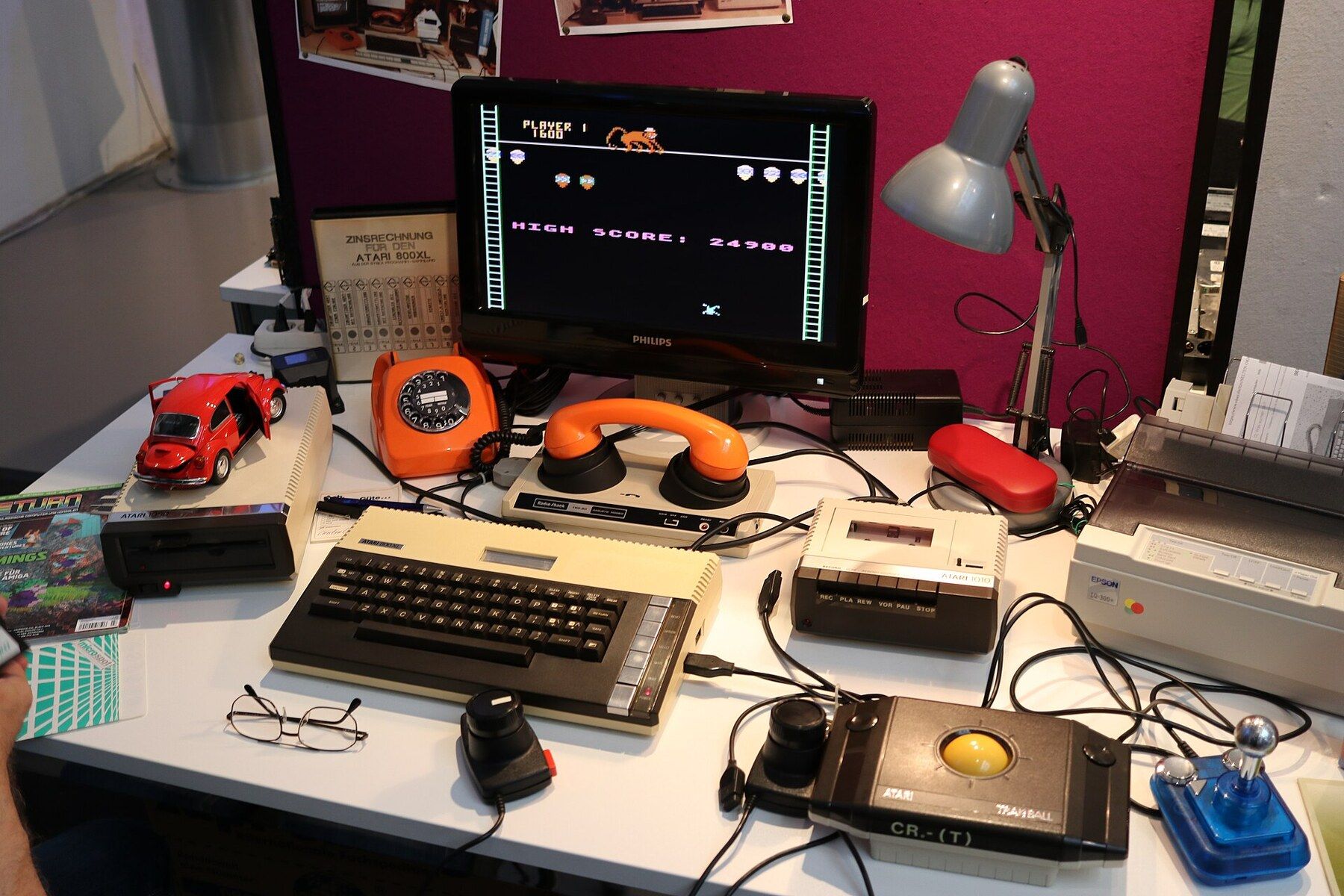
Atari’s 8-bit computers were a family of 6502-based home computers sold from late 1979 into the early 1990s, first by Atari, Inc. and, from July 1984, by Jack Tramiel’s Atari Corporation. Every model, from the 400 and 800 to the XE Game System of 1987, used the same Atari-designed chips and the same serial bus for peripherals, so most software and add-ons carried over from one generation to the next. Atari Corporation ended support for the line at the start of 1992, while XE machines were still being built for export that year.
The models at a glance
| Model | Announced | On sale | RAM | US launch price |
|---|---|---|---|---|
| 400 | November 1978 | October 1979 | 8 KB, later 16 KB | US$549.99 |
| 800 | November 1978 | October 1979 | 8 KB to 48 KB | US$999.99 with recorder |
| 1200XL | December 1982 | March 1983 | 64 KB | US$899 |
| 600XL | June 1983 | October or November 1983 | 16 KB | US$199 |
| 800XL | June 1983 | Late 1983 | 64 KB | US$299 |
| 1400XL | June 1983 | Never shipped | 64 KB | Not set |
| 1450XLD | June 1983 | Never shipped | 64 KB | Not set |
| 130XE | January 1985 | Spring 1985 | 128 KB | US$149 |
| 65XE | January 1985 | 1985 abroad, March 1986 in the US | 64 KB | US$99.95 |
| 800XE | March 1987 | 1987, Europe only | 64 KB | Not sold in the US |
| XE Game System | February 1987 | October 1987 | 64 KB | US$150 |
Dates and prices come from Michael Current’s Atari 8-bit FAQ, checked against Compute! and Antic where those magazines give them. The 400 and 800 were announced in a Warner press release in November 1978 and presented to the press in New York that December; their prices are the list prices of June 1979. The 1200XL price is the one announced at the January 1983 CES. For the two models that never shipped, Compute! reported in August 1983 that sources expected US$500 to US$600 for the 1400XL and about US$1,000 for the 1450XLD, while Antic’s December 1983 buyer’s guide listed US$545 and US$999.
The 400 and 800
Atari, Inc., then owned by Warner Communications, announced the 400 and 800 at the end of 1978 and began shipping them in October 1979. The 400 had a flat membrane keyboard and one cartridge slot; the 800 had full-travel keys, two cartridge slots, a monitor jack and memory boards under its lid. Because both fed a television, FCC rules shaped their shielding and their serial bus. Production in Sunnyvale ended in May 1983. The Atari 400 and 800 page covers their development, prices and revisions.
The 1200XL
The 1200XL, announced in December 1982 and shipped in March 1983 at US$899, put the 800’s chips on one board with 64 KB, function keys, a HELP key and a new 16 KB operating system. It lost two controller ports, the second cartridge slot and any expansion, and its operating system broke some older programs. Atari dropped it at the June 1983 Consumer Electronics Show, and production ended in July. Its history is on the Atari 1200XL page, and the plan it came from on the Sweet 16 project page.
The 600XL and 800XL
Atari, Inc. introduced the 600XL and 800XL at the Summer CES in Chicago, June 5 to 8, 1983, at US$199 and US$299. Compute! described both as having Atari BASIC built in and a rear edge connector carrying the full processor bus, the Parallel Bus Interface (PBI). The 600XL had 16 KB and no monitor jack; the 800XL had 64 KB. Neither kept the 1200XL’s F1 to F4 keys, and both had two controller ports. A memory module that took the 600XL to 64 KB, the 1064, was introduced in January 1984.
Supply was short at first. On November 2, 1983 the Christian Science Monitor quoted Atari spokesman Bruce Entin on demand “outstripping supply” for both models and reported that the company was “just now shipping” the 800XL. The FAQ cites the Wall Street Journal of the same day for Atari’s statement that production problems in Hong Kong would let it fill only 60 percent of Christmas orders, and dates the first, small shipments of the North American 800XL to December 1983. In November 1983 Atari announced increases of 17 to 29 percent from January 1, 1984: dealer prices rose by US$40, and the suggested retail prices became US$249 for the 600XL and US$399 for the 800XL.
On July 2, 1984 Warner and Jack Tramiel’s company announced the sale of Atari’s home computer and video game businesses. Business Week then reported that the new owners had cut several products, including “the $150 600XL home computer”. The FAQ records the 800XL’s retail price at US$179 from September 1, 1984 and US$119 in November. A revised 800XL board, dated September 1984 in the FAQ, added a memory controller chip called FREDDIE; the FAQ lists it in PAL units and in the SECAM version sold in France.
The 1400XL and 1450XLD, announced but never shipped
Compute! described the two higher models shown in June 1983. The 1400XL looked almost identical to the 1200XL, function keys included, but added the rear expansion connector, a built-in 300-baud modem and a Votrax speech synthesizer that programs could address as ordinary devices. The 1450XLD had the same features plus a double-sided disk drive holding up to 254 KB per disk, with room for a second drive. In the fall of 1983 Atari said, according to the Wall Street Journal as quoted in the FAQ, that both would ship in limited quantities in late December and more widely after the new year. An internal Atari note of December 6, 1983, also quoted in the FAQ, states that “for all practical purposes” the 1400XL had been canceled. At the January 1984 CES Atari promised only the 1450XLD; it was redesigned during 1984 but never reached stores.
The XE models under Atari Corporation
At the Winter CES in January 1985, the show where it also introduced the ST, Atari Corporation announced the 65XE and the 130XE. Compute! gave their prices as US$99 and about US$150; the FAQ records Atari’s own figures at the show as “under $120” and “well under $200”. Compute! called the 65XE “basically a remodeled 800XL” and noted that the new cases echoed the ST design. The 130XE added 128 KB and a rear connector, the ECI; according to the FAQ it had shipped in the United States by the end of March 1985 at US$149. A portable 65XEP was previewed at the show, and a 65XEM with an added sound chip had been announced before it; neither shipped. The 65XE went on sale outside the United States first and, according to atarimuseum.de, only reached American stores in March 1986, once stocks of the 800XL had run out.
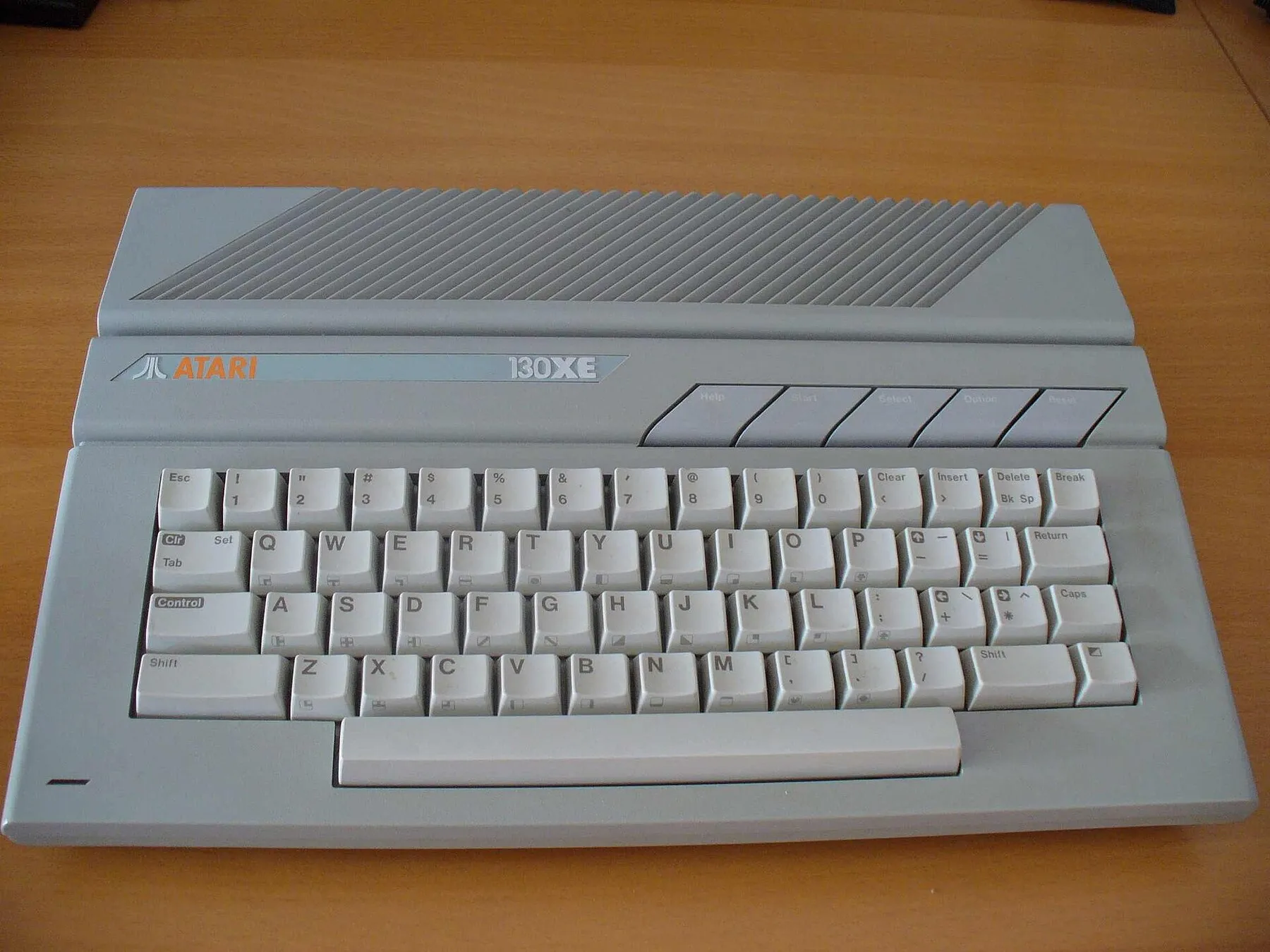
The 800XE, presented in 1987 for European markets, was a 65XE under another name; atarimuseum.de describes its popularity in Central and Eastern Europe, and Atari Corporation’s 1987 annual report, as quoted in the FAQ, said the 800XE and 65XE had “gained brand dominance” in Czechoslovakia, East Germany and Poland.
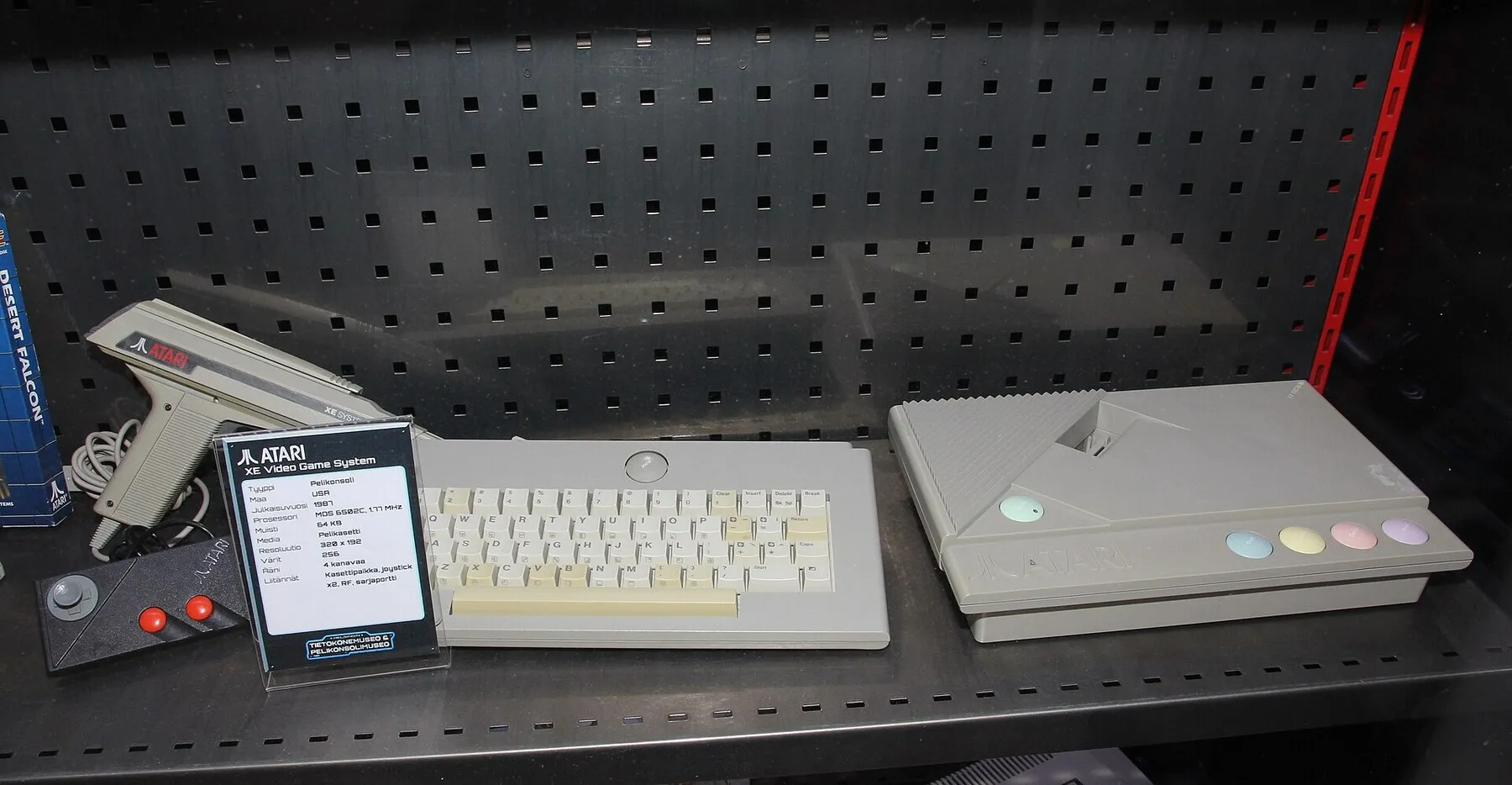
The XE Game System, shown at the American International Toy Fair in New York in February 1987, repackaged the 65XE as a console with a detachable keyboard. It came with a joystick, the XG-1 light gun, Missile Command and BASIC in ROM, and the Flight Simulator II and Bug Hunt cartridges. Antic put it at “under $150” in June 1987; the FAQ records that it reached most dealers by mid-October 1987 at US$150. The FAQ also quotes two sales figures that are far apart: 100,000 sold in the United States at Christmas 1987, reported by Antic, and Atari Corporation’s claim, printed in Compute! in May 1988, of “more than 2 million XE game systems sold in 1987”.
The shared chips
Antic summed up the design in 1984: all Atari computers “operate in essentially the same way”, with a 6502 supported by ANTIC, GTIA (CTIA in early models), POKEY and a PIA. Their roles:
- ANTIC is a display processor with its own program, the display list, which tells it line by line which text or graphics mode to draw and where the data sits. Different modes can share one screen, and scrolling is done in hardware.
- CTIA, replaced by GTIA from late 1981, turns ANTIC’s output into color, draws the player-missile graphics (Atari’s term for sprites) and detects collisions. GTIA adds three graphics modes.
- POKEY produces four channels of sound and also handles the keyboard, the paddle controllers and the serial port.
- PIA reads the joysticks. Antic explained that dropping ports 3 and 4 on the XL and XE models freed the lines that served them, which now switch the operating system and BASIC in and out.
Later machines replaced the 6502 with SALLY, an Atari version of the chip, and late 800XL and XE boards added FREDDIE. The XL operating system, introduced with the 1200XL, broke some programs written for the 400 and 800; the Translator disk from Atari, Inc., US$9.95 according to Antic in 1984, loads the old operating system into memory to run them.
Peripherals on the SIO bus
Every 8-bit Atari has an SIO port, and most peripherals have two, so devices connect in a chain. Atari’s own SIO peripherals included:
| Model | Type | Introduced | Notes |
|---|---|---|---|
| 410 | Program recorder | 1979 | About 100 KB per 60-minute cassette at 600 baud |
| 810 | 5.25-inch disk drive | 1979 | Single density, 90 KB per disk |
| 820 | Printer | 1979 | 40-column dot matrix |
| 850 | Interface module | 1980 | Four RS-232 serial ports and a parallel printer port; US$219.95 |
| 1010 | Program recorder | 1983 | Repackaged 410; US$99.95 |
| 1020 | Color printer and plotter | 1983 | Four pens, 40-column roll paper; US$299 |
| 1025 | Printer | 1983 | 80-column dot matrix; US$549 |
| 1027 | Printer | 1983 | Letter quality; US$349 |
| 1050 | 5.25-inch disk drive | 1983 | Enhanced density, about 130 KB per disk; US$449 |
| XF551 | 5.25-inch disk drive | 1987 | Double density, double-sided, 360 KB per disk |
Prices for the 1010, 1020 and 1025 come from Compute! in March 1983, those for the 1027 and 1050 from its August 1983 show report, and the rest from the FAQ. Atari also sold the 822 and 825 printers, later the XMM801 and XDM121, and the 830, 835, 1030, XM301 and SX212 modems.
The 810 and 1050 drives. The 810, Atari’s first drive, stores 90 KB on one side of a 5.25-inch disk, and up to four can be used at once. The FAQ notes a faster ROM from November 1981 and a switch from MPI to Tandon drive mechanisms in November 1982. The 1050 replaced it from June 1983, at a list price of US$449. Atari called its new mode “double density”, but it stores about 130 KB (127K according to Compute! and Antic), short of the 180 KB of true double density, so it is usually called enhanced or dual density; the drive still reads and writes 810 disks. Compute! reported in August 1983 that the 1050 would ship with the single-density DOS II until DOS III was ready, and the FAQ records DOS 2.5 replacing DOS 3 with the drive from March 1985. The XF551 of 1987 brought true double density and a second head.
Some announced peripherals never shipped: the 815 dual drive shown in 1980, the 1060 CP/M module, canceled in January 1984, and the 1090 XL Expansion System for the PBI, of which only prototypes were made.
The end of the line
Sales declined at the end of the 1980s. Atari Corporation’s 1990 annual report gives a 35 percent drop in 1989, to US$101.6 million, for its game products and “the range of older XE 8 bit computers”, and a further decrease in 1990 in sales of “XE computer and traditional video game products, especially in the U.S. market”. According to atarimuseum.de, development of new XE products stopped in the spring of 1989; production ran in Taiwan until the summer of 1991 and then in China until the end of 1992.
The FAQ’s timeline, built from magazine reports, records the last steps:
- May 1991: Atari Canada offered owners of 8-bit computers a trade-up to a 520STFM and admitted that the line was discontinued (AtariUser, January 1992);
- May 14, 1991: Atari Corporation told its shareholders that the XE was still in production for South America, Eastern Europe and the Middle East (Atari Interface, June 1991);
- Christmas 1991: Atari Corporation dropped the XE Game System, the 2600 and the 7800 (AtariUser, July 1992);
- early 1992: Atari Corporation ended support for all 8-bit products (Atari Classics, December 1992);
- June 2, 1992: XE machines were still being made for Mexico, South America, Eastern Europe and Germany, though no longer sold in the United States (Atari Interface, fall 1992);
- end of 1992: Atari Corporation’s annual report for the year was the first not to mention the XE.
Sources
- Atari 8-Bit Computers: Frequently Asked Questions, Michael Current
- Atari's New Top-Line Home Computer, Compute!, issue 34, March 1983
- The Fall Computer Collection At The Summer Consumer Electronics Show, Compute!, issue 39, August 1983
- Computer sugarplums are in short supply, The Christian Science Monitor, November 2, 1983
- Buyer's Guide, Antic, vol. 2 no. 9, December 1983
- Inside Atari: Evolution of the XL Computers, Antic, vol. 3 no. 2, June 1984
- The Next Generation: New Computers at the Winter Consumer Electronics Show, Compute!, issue 59, April 1985
- Atari News Update: XE Game System, Antic, vol. 6 no. 2, June 1987
- Atari Corporation Annual Report 1990, Atari Corporation, scan hosted by Atarimania, 1991
- Atari 65XE / 800XE, atarimuseum.de
- Atari 8-bit computers, Wikipedia
Last reviewed October 30, 2026.
Related pages
- Atari 400 and 800
Atari's first home computers, announced late in 1978 and shipped from October 1979: a sealed, low-cost 400 and an expandable 800 on the same chips
- Atari 1200XL
The 64 KB successor to the Atari 800, announced in December 1982, shipped in March 1983 at US$899 and out of production by July
- The Atari Sweet 16 project
The 1982 Atari, Inc. plan for a smaller, cheaper successor to the 800, which reached stores in reduced form as the 1200XL
- Atari ST family
Atari Corporation's 68000 and 68030 computers, from the 520ST of 1985 through the Mega ST, STE and TT030 to the Falcon030 of 1992
- Atari corporate history: from Atari, Inc. to Atari SA
Atari, Inc., Warner, the 1984 split, Atari Corporation, Atari Games, JTS, Hasbro Interactive, Infogrames and Atari SA, with dates and prices