Atari ST family
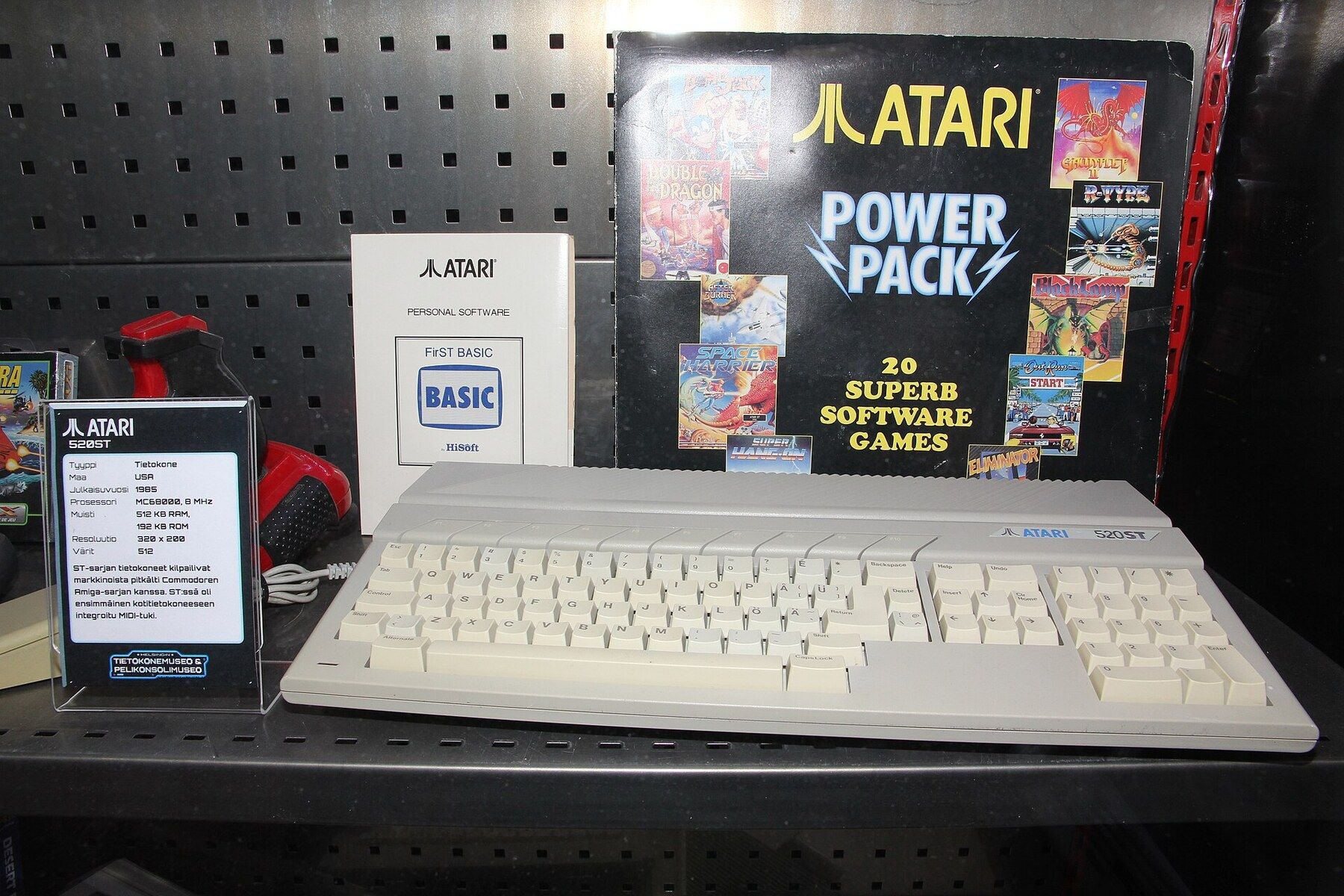
The Atari ST family is the line of Motorola 68000 and 68030 computers that Atari Corporation sold from 1985 to 1993, from the 520ST to the Falcon030. Every model ran TOS with Digital Research’s GEM desktop and kept the built-in MIDI ports of the first machine, which drew musicians and music software houses to the platform. The ST sold better in Europe than in the United States, especially in West Germany. Atari Corporation decided in 1992 and 1993 to leave the computer business and put its resources into the Jaguar console.
ST models from 1985 to 1993
Several models were shown at a trade fair months before they reached shops, and some went on sale in Europe before the United States. The table gives the year of first sale, with the year of the first showing when the two differ.
| Model | Year | CPU | RAM | What was new |
|---|---|---|---|---|
| 520ST | 1985 | 68000, 8 MHz | 512 KB | First ST: GEM desktop, MIDI and DMA ports |
| 1040ST F | 1986 | 68000, 8 MHz | 1 MB | Double-sided drive and power supply inside the case |
| Mega ST 2, Mega ST 4 | 1987 | 68000, 8 MHz | 2 or 4 MB | Separate keyboard, Blitter chip, battery-backed clock, expansion connector |
| 520STE, 1040STE | 1989 | 68000, 8 MHz | 512 KB or 1 MB | 4,096-color palette, stereo sampled sound, hardware scrolling |
| STacy | Shown 1989, shipped 1990 | 68000, 8 MHz | 1 MB | Laptop with backlit LCD and built-in trackball |
| TT030 | 1990 | 68030, 32 MHz | 2 or 4 MB in the first US packages | New modes up to 1280 × 960, VMEbus slot |
| Mega STE | 1991 | 68000, 8 or 16 MHz | 1 to 4 MB | TT-style case, 16 KB cache, VME slot |
| ST Book | 1991 | 68000 | 1 or 4 MB | Notebook with a hard disk and no floppy drive |
| Falcon030 | Shown 1992, sold 1992 or 1993 by country | 68030, 16 MHz | 1, 4 or 14 MB | DSP56001 signal processor, 16-bit stereo sound, 16-bit color |
1040ST F and Mega ST
Atari Corporation introduced the 1040ST at the Winter Consumer Electronics Show in January 1986. Compute! called it the first computer with 1 MB of RAM to sell for less than US$1,000: it listed at US$999.95 with a monochrome monitor and US$1,199.95 with a color monitor, through computer dealers only. Apart from the memory, the changes were practical: the double-sided 3.5-inch drive and the power supply moved inside the case, and TOS came in ROM, as on recent 520STs.
The Mega ST, announced at CES in January 1987, separated the keyboard from a flat system unit that held the drive, a battery-powered clock, a bus connector for expansion cards and what ANTIC called “the long-awaited blitter chip”, a graphics coprocessor for fast screen operations. According to Antic, the Mega ST 2 and Mega ST 4 reached US dealers at the end of September 1987, at US$1,699 and US$2,399 with a monochrome monitor and US$200 more with color.
STE and TT030
Atari Corporation showed both a revised ST and a new 68030 machine at the Atari fair in Düsseldorf in August 1989. The STE kept the 8 MHz 68000 and the ST screen modes, but START reported a palette raised from 512 to 4,096 colors, two 8-bit digital-to-analog converters for stereo sampled sound and hardware fine scrolling. The dates differ by source: Sam Tramiel told START the STE would reach Europe in September and the United States in October 1989, while the annual report says volume shipments began in the fourth quarter of 1989 and places the US launch in the second quarter of 1990.
The 1989 annual report described the TT030 as a 16 MHz machine to ship in the second half of 1990. It reached German shops after the 1990 Düsseldorf fair with the 68030 at 32 MHz and TOS 3; Z*Net reported that from December 1, 1990 Atari Deutschland cut the price of a 4 MB unit with a 48 MB hard disk and no monitor to DM 4,298. In the United States the TT, introduced at Fall Comdex in 1989, failed FCC testing in 1990. START reported in spring 1991 that it was shipping to US dealers with a Class A rating for business use, through value-added resellers, at US$2,995 with 2 MB and a 50 MB hard disk; Dave Small’s review in the same magazine gave that price for 4 MB and a 40 MB disk. Small also noted that only the processor runs at 32 MHz, the rest of the system at 16 MHz. The new video modes go up to 1280 × 960 in monochrome and 320 × 480 in 256 colors. Unix came later: at the 1991 Düsseldorf fair, TOS magazine reported, Atari offered developers a Unix TT with 8 MB and a 200 MB disk for about DM 8,000, while end users still had to wait.
Mega STE and Falcon030
The Mega STE, shown at Fall Comdex in November 1990, put STE hardware in a grey version of the TT case, according to Z*Net. Its 68000 switches between 8 and 16 MHz and has a 16 KB cache, though TOS magazine noted that memory is still accessed at 8 MHz. ST-Magazin gave a US price of US$1,799.95 with 2 MB and a monochrome monitor in January 1991, and START reported in spring 1991 that the Mega STE had passed FCC Class B testing, which allows sale for home use.
The Falcon030 began as a home computer project called FX-1, which atarimuseum.de says was first shown at CeBIT in March 1992. Atari Corporation announced it as the Falcon030 at the Atari fair in Düsseldorf on August 21 to 23, 1992, according to Atari Explorer Online: a 16 MHz 68030, a Motorola DSP56001 digital signal processor, 16-bit stereo DMA sound and 1, 4 or 14 MB of RAM. The announced US prices were US$799 for 1 MB and US$1,399 for 4 MB with a 65 MB hard disk, with US shipping planned for October 1992 pending FCC approval.
The sale dates differ by country and by source. TOS magazine dated the start of the German market launch to early November 1992, at DM 2,298 for the 4 MB model with a hard disk. atarimuseum.de gives January 1993 for Europe in its text, but its table lists November 1992, then March 1993 for the United Kingdom and June 1993 for the United States. In the United States, STReport reported that the Falcon030 had first passed FCC Class B on November 5, 1992 on condition that a ferrite-bead monitor cable be supplied, and was certified again without that cable on January 8, 1993. Atari Explorer Online reported in June 1993 that Falcons were being shipped to dealers.
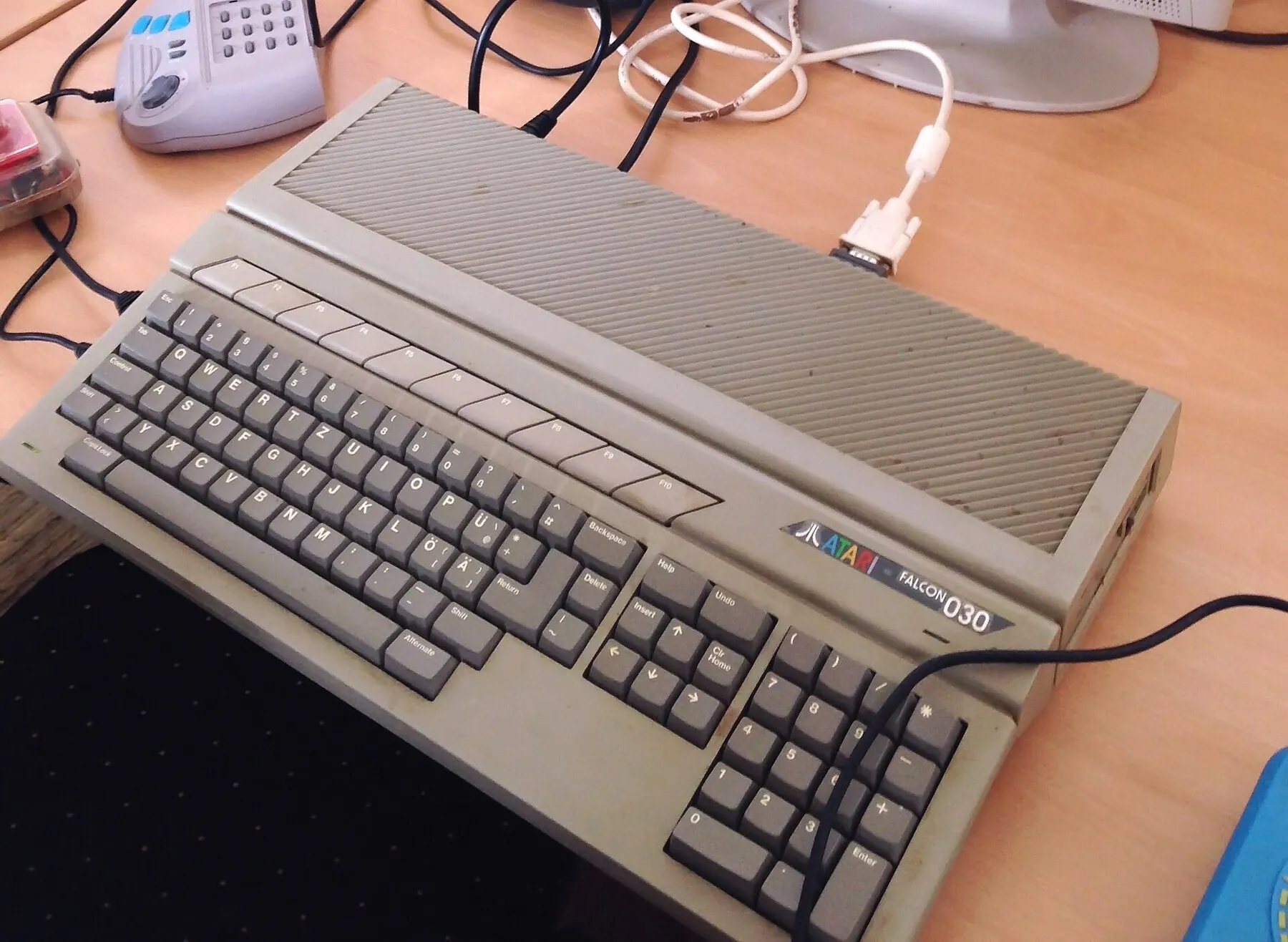
The Falcon030’s VIDEL video chip draws from 262,144 colors, offers a 16-bit true-color mode, and drives both ST monitors and VGA monitors through adapters. Its operating system is TOS 4, and Atari announced MultiTOS, a multitasking version, alongside it.
TOS versions and the GEM desktop
Every ST runs TOS, Atari Corporation’s operating system, with the GEM desktop licensed from Digital Research. The 520ST page explains why the first version shipped on a floppy disk. Later versions followed the hardware:
- TOS 1.4 (1989): an update for existing STs. In an interview published by START in September 1989, Sam Tramiel said it was already going into Mega production and would be sold as an upgrade kit for US$99 or less.
- TOS 1.6 (1989): the STE version, according to START.
- TOS 2 (1990): the Mega STE, with the TT-style desktop.
- TOS 3 (1990): the TT030.
- TOS 4 (1992): the Falcon030, with MultiTOS.
Portables: STacy, ST Book and the ST Pad
STacy. At the spring 1989 COMDEX, Atari Corporation presented the STacy as a laptop version of the 1040ST, with 1 MB, a supertwist LCD, a weight under 15 pounds with batteries and a price under US$1,500. ST-Log reported that Atari expected MIDI users to account for most sales and promised shipments for June or July 1989. START’s October 1989 review described a backlit screen, a built-in trackball in place of the mouse, a case designed by Ira Velinsky, a price of US$1,499 for the single-drive model and a rollout set for September 1. Atari’s 1989 annual report says shipments began only at the end of the first quarter of 1990. START gave the screen as 640 × 480; the annual report gives 640 × 400, the ST’s monochrome resolution.
ST Book. Atari Corporation showed the ST Book at CeBIT in Hanover in March 1991. ST Computer described a machine of 30 × 21 cm and about 1 kg, with 1 MB (4 MB to follow), a 20 MB hard disk, a small built-in pad in place of a mouse, and a 640 × 400 LCD left unlit to save power; Atari quoted about 10 hours on batteries. It has no floppy drive, but an external one can be connected. At the 1991 Atari fair in Düsseldorf, TOS magazine saw pre-production units under 2 kg with a 40 MB disk, MIDI ports, at least five hours of battery life and a price of about DM 4,000 for the 1 MB version, due in shops in October. No Atari production figure has been found; the archived Atari Historical Society page put the number at about 1,000, most of them sold in Europe.
ST Pad. The ST Pad, shown as a prototype at the same CeBIT, replaced keyboard and mouse with a pen and handwriting recognition. ST Computer reported an A4-size tablet slightly over 1 kg, with 1 or 4 MB and two slots for memory cards (“silicon drives”) instead of floppy drives. The Atari Museum gives STylus as its early name. It was never produced.
Atari peripherals for the ST
Atari Corporation sold its own drives, monitors and printers for the line. Prices are those quoted at the time.
- SF354 and SF314 floppy drives. Single-sided and double-sided 3.5-inch drives for the first STs, at US$199.95 and US$299.95 in Antic’s December 1985 buyers’ guide.
- SM124 and SC1224 monitors. The SM124 monochrome monitor shows the 640 × 400 mode, at US$199.95; the SC1224 RGB color monitor cost US$399.95 in the same guide.
- SH204 hard disk. A 20 MB drive for the DMA port, announced as available at US$799.95 in summer 1986, according to Compute!. Atari’s Megafile 20 and Megafile 40 drives were shown at Fall COMDEX in November 1987.
- SLM804 laser printer. Announced at CES in January 1987 for under US$1,500 (ANTIC). When it finally shipped in 1988, START listed it at US$1,999.95: 8 pages per minute at 300 dpi, with no processor or page memory of its own. The ST computes the page and sends it through the DMA port.
Music, publishing and CAD
By 1989 the music press was reviewing sequencers written for the ST. Sound On Sound reviewed Steinberg’s Cubase, the successor to its Pro-24, in August 1989; Micro Music reviewed C-Lab’s Creator, sold with the Notator scoring program, in its June/July 1989 issue and named the ST’s high-resolution display, large memory, built-in MIDI ports and fast processing as what made it a good host for the package. Z*Magazine reported that Atari Corporation was virtually the only computer maker exhibiting at the NAMM music trade show in January 1992.
Desktop publishing was the other market Atari Corporation pursued. Its 1987 pitch was a Mega ST 2 with a laser printer for under US$3,000, and its 1989 annual report states that the report itself was created with DeskSet II on a Mega ST 4 with a Megafile 44 removable-cartridge hard disk and an SLM804, then typeset on an AGFA Compugraphic typesetter. In Germany, TOS magazine headlined its report on Atari’s 1990 press conference “Die Zugpferde: DTP und MIDI” (the workhorses: DTP and MIDI), and Atari Deutschland said the share of Mega STs in its deliveries had doubled with its publishing push.
CAD was a third professional use. ST-Magazin dated the first version of Campus CAD, from Technobox in Bochum, to early 1987, at about DM 800, and ST Computer ran a feature on the ST as a CAD workstation in June 1989. At CeBIT 1991, CRP Koruk showed DynaCADD 1.84 for the ST and TT, the Amiga and the PC, at DM 3,000.
Why the ST sold best in Europe
The sources measure the European share in different ways:
- Compute! reported in April 1986 estimates of at least 100,000 520STs sold worldwide through Christmas 1985, and wrote that about half of all ST sales were in Europe.
- The New York Times wrote in August 1987 that two-thirds of Atari’s personal computers were sold in Europe. In the same article Atari Corporation announced it would buy Federated Group, a US electronics chain, for more than US$67 million, and said it had begun recruiting music stores as dealers.
- Atari’s 1989 annual report gives Europe as 56 percent of total sales in 1987 and 65 percent in 1988.
- In spring 1988, ST Computer and Amiga Computing both reported 250,000 STs sold in West Germany. Amiga Computing added that 150,000 of them had been sold in the previous twelve months, against 160,000 Amigas sold there in all.
- At the 1990 press conference Alwin Stumpf, managing director of Atari Deutschland, reported 135,000 STs delivered in 1989. TOS magazine’s report does not make clear whether that figure covers Germany alone.
In START’s 1988 retrospective, Leonard Tramiel explained the gap: in Europe the PC, the Macintosh and the ST had arrived at about the same time, while in the United States the IBM PC was entrenched and Atari could not match Apple’s advertising. He added: “the phrase, ‘No one was ever fired for buying an IBM’ I don’t believe has ever been translated into German.”
The Amiga rivalry
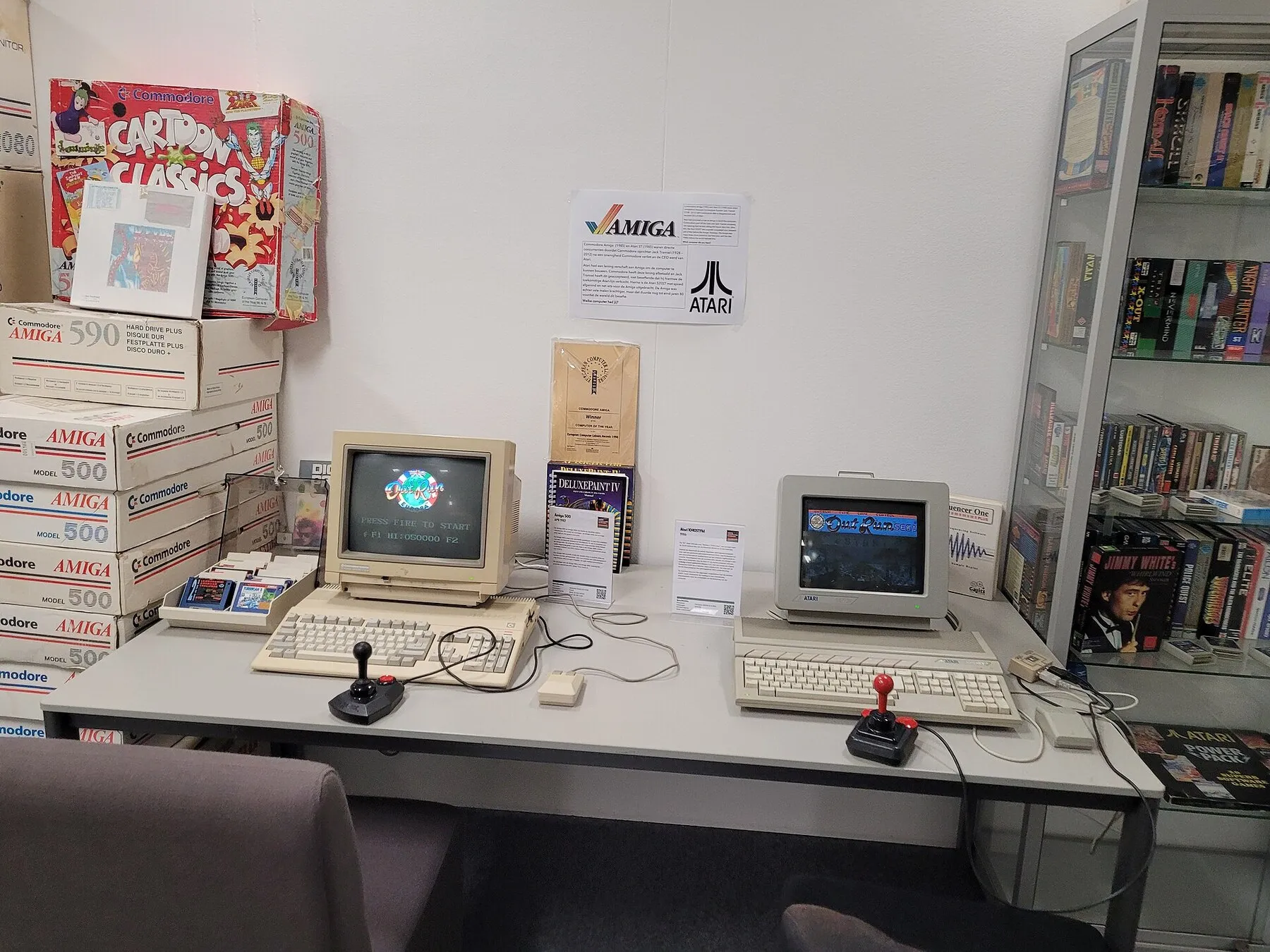
The ST’s direct competitor was the Commodore Amiga. Atari, Inc. had paid Amiga Corporation US$500,000 to develop three chips; Amiga returned the money, agreed to be bought by Commodore, and Atari Corporation, by then under Jack Tramiel, sued it in August 1984, the New York Times reported. The computers hub covers the 1850XLD that Atari, Inc. had planned around those chips.
For 1985, Compute! set its estimate of at least 100,000 520STs against at least 20,000 Amigas. Commodore’s cheaper Amiga 500 arrived in 1987, at a list price of US$595 with 512 KB and no monitor, according to Compute! in October 1987.
Planned models that never shipped
- EST. START described the “EST” in 1988 as a coming machine at about the Mega’s price, with three new screen modes including 1280 × 960 monochrome. The archived Atari Historical Society page, citing the German magazine Data Welt of May 1986, lists a 68020 machine with 4 MB and Unix or TOS. Nothing shipped under that name; the 1280 × 960 mode arrived with the TT030.
- Falcon variants. atarimuseum.de describes plans for a Falcon in a different case with three expansion slots. The archived Atari Historical Society page names a MicroFalcon with a detachable keyboard and a larger desktop Falcon040, both canceled.
- Transputer workstation. The ATW800, built around a Mega ST board, is covered on the computers hub.
The end of the line in 1993
Atari Corporation’s annual filing for 1994 summarizes the decision: “In 1992 and 1993, the Company significantly downsized operations, decided to exit the computer products business and refocused on its video game business.” Computer products still made up 67 percent of its sales in 1993, the year it wrote down inventories of older 16-bit computers and Falcon products while launching the Jaguar in the fourth quarter. By early 1995 the filing reported that the company “has exited the computer business and is selling off those remaining inventories”.
atarimuseum.de dates the end of Atari’s Falcon distribution to 1994. The design continued outside Atari: the Hamburg software house C-Lab licensed the Falcon hardware in 1995 and sold its own versions, the last of them, the Falcon MK-X in a desktop case, in 1996.
Sources
- A Turning Point for Atari? Report from the Winter Consumer Electronics Show, Compute!, issue 71, April 1986
- Three Years with the ST, START magazine, vol. 3 no. 1, Summer 1988
- Atari's New Computers, ANTIC, vol. 6 no. 1, May 1987
- ST Resource: Mega 4 Computer, Antic, vol. 6 no. 9, January 1988
- 1st Annual ST Shoppers Guide, Antic, vol. 4 no. 8, December 1985
- 16-Bit Explosion, Compute!, issue 75, August 1986
- Products Update, START magazine, vol. 3 no. 1, Summer 1988
- COMDEX, Spring 1989, ST-Log, issue 35, August 1989
- From Atari's Oval Office, START magazine, vol. 4 no. 2, September 1989
- The Traveling Computers, START magazine, vol. 4 no. 3, October 1989
- The Future of Atari Computing, START magazine, vol. 4 no. 5, December 1989
- Atari Corporation Annual Report 1989, Atari Corporation, via Internet Archive, 1990
- Die Zugpferde: DTP und MIDI - Atari Pressekonferenz '90, TOS magazine, May 1990
- Z*Net Online, issue 548, Z*Net, via AtariArchives.org, December 8, 1990
- Z*Net Newswire: Atari at Comdex 1990, Mega STE a Reality, TT 030: Old News-Great Machine, START magazine, vol. 5 no. 6, February/March 1991
- TTerrific!, START magazine, vol. 5 no. 6, February/March 1991
- Z*Net Newswire: TT, Mega STE Pass FCC, START magazine, vol. 5 no. 7, April/May 1991
- Atari Mega STE, ST-Magazin, January 1991
- Mega STE, TOS magazine, February 1991
- CeBIT 1991, ST Computer, May 1991
- Atari-Messe, TOS magazine, October 1991
- Atari Explorer Online, issue 92-12, Atari Explorer Online, via AtariArchives.org, August 1992
- STReport, issue 9.02, STReport Online Magazine, via AtariArchives.org, January 1993
- Test: Atari Falcon 030 - Multitalent Falcon, TOS magazine, December 1992
- Atari Explorer Online, issue 0211, Atari Explorer Online, via AtariArchives.org, June 26, 1993
- Atari Falcon 030, Atari Computermuseum (atarimuseum.de)
- Atari history 1987, Atari Computermuseum (atari-computermuseum.de)
- Atari ST Pad prototype, Atari Museum (Atari Explorer archive)
- Atari to Acquire Electronics Retailer, The New York Times, August 25, 1987
- Battle of the German giants, Amiga Computing, June 1988
- CeBIT 88, ST Computer, June 1988
- Steinberg Cubase, Sound On Sound, August 1989
- C-Lab Creator, Micro Music, June/July 1989
- Campus CAD, ST-Magazin, June 1989
- CAD-Workstation ST, ST Computer, June 1989
- Z*Magazine, issue 202, Z*Magazine, via AtariArchives.org, January 27, 1992
- Atari Head Sues Ally That Defected to Rival, The New York Times, August 21, 1984
- Compute!, issue 89, Compute!, via Internet Archive, October 1987
- The Atari EST Advanced Computer System (archived Atari Historical Society page), Internet Archive
- History Notes: The Atari ST Line of Computers (archived Atari Historical Society page), Internet Archive
- Atari Corporation Form 10-K for the fiscal year ended December 31, 1994, U.S. Securities and Exchange Commission, 1995
Last reviewed October 30, 2026.
Related pages
- Atari 520ST
The first ST: a 68000 machine with 512 KB, a GEM desktop and MIDI ports, shipped by Atari Corporation in July 1985
- Atari computers
The 8-bit line of 1979 to 1992, the ST family of 1985 to 1993, and Atari Corporation's PC compatibles, Portfolio palmtop and transputer workstation
- Atari Jaguar
Atari Corporation's cartridge console with Tom and Jerry chips by Flare II, sold as 64-bit from November 1993, with production orders stopped in mid-1995
- Atari corporate history: from Atari, Inc. to Atari SA
Atari, Inc., Warner, the 1984 split, Atari Corporation, Atari Games, JTS, Hasbro Interactive, Infogrames and Atari SA, with dates and prices