Atari 400 and 800
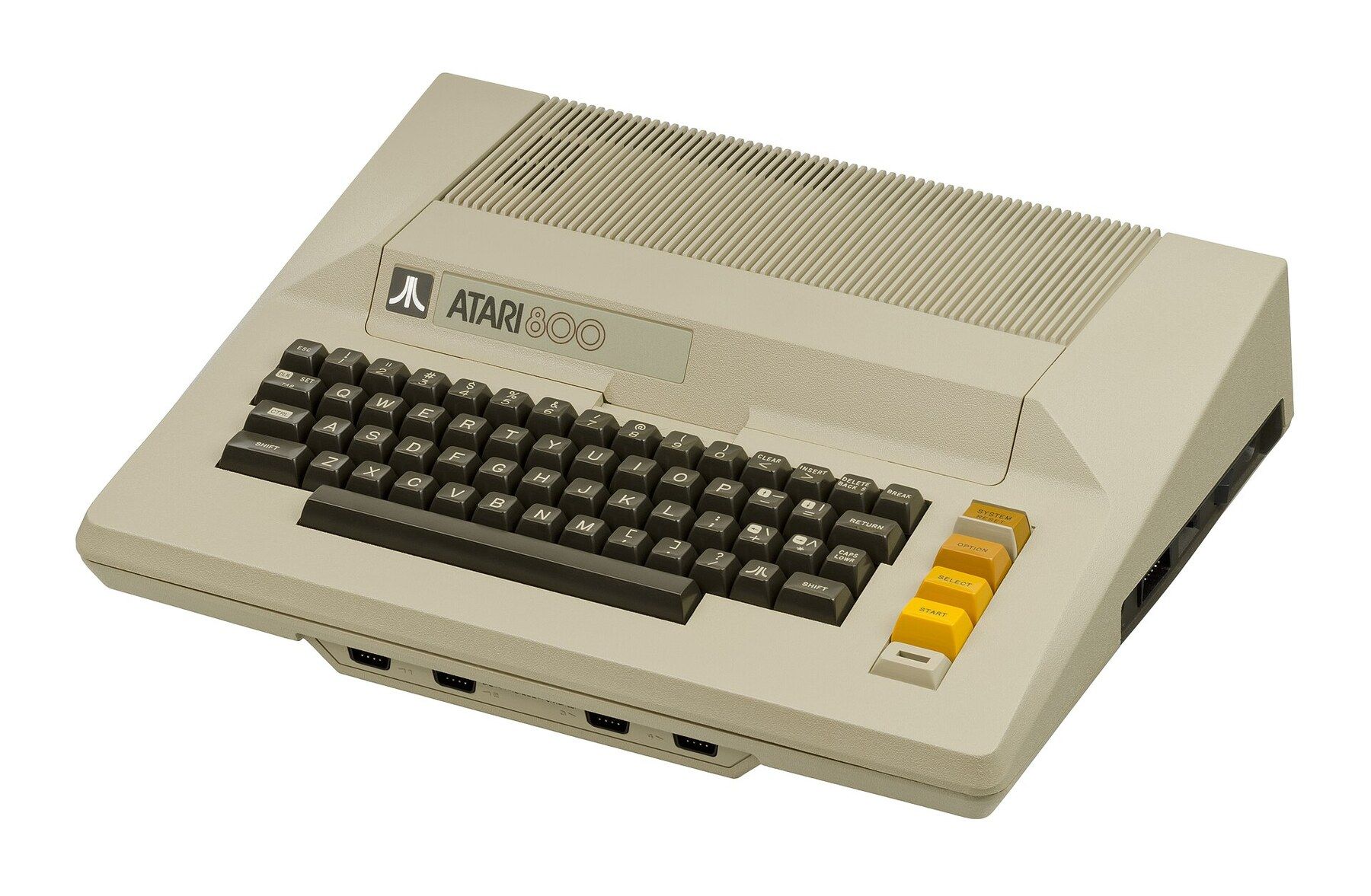
The Atari 400 and 800 were the first home computers from Atari, Inc., then a subsidiary of Warner Communications. Warner announced them in November 1978, Atari presented them at a New York press conference on December 14, 1978 and at the Winter Consumer Electronics Show (CES) in Las Vegas in January 1979, and shipments began in October 1979. Both used a 6502 processor and the same three Atari-designed chips; the 400 was the low-cost model with a flat keyboard and fixed memory, the 800 the expandable one.
Colleen and Candy: one design, two machines
Michael Current’s Atari 8-bit FAQ, drawing on engineer Joe Decuir’s 1977 notebook, dates the acceptance of the “Colleen” proposal by Steve Mayer and Decuir to August 1977, with Jay Miner as chief engineer of the project. By November 1977 three versions were under study: Colleen, the full system; Candy, a game machine with no keyboard and no expansion; and Elizabeth, a Colleen with a 13-inch color monitor. In August 1978 Candy was redrawn with a built-in membrane keyboard and became a computer. Colleen shipped as the 800 and Candy as the 400.
Decuir, interviewed by the Atari Museum, and the FAQ both credit ANTIC, the display chip, to Decuir with François Michel, CTIA to George McLeod and POKEY to Doug Neubauer. US patent 4,296,476, filed on January 8, 1979 and granted on October 20, 1981, covers the “programmable graphics generator” and names Mayer, Miner, Neubauer and Decuir as inventors.
How FCC rules shaped the design
Both computers connect to a television, and that set the constraints. Decuir told the Atari Museum that Atari had to meet the FCC’s Part 15 Type I rules “for anything that actually generated TV channel RF”, which were stricter than the limits for ordinary computers. As a result, he said, “slots were out”, and the electronics ended up wrapped “in a 2mm thick aluminum casting”. Peripherals connect instead through the serial bus, SIO, which Decuir called “a kludge, running at 19,200 bps”, adding that it was expensive: “I think it sank the product.” He contrasts this with Apple, which left the RF modulator out of the Apple II and so avoided the issue.
The FAQ records an Atari announcement on June 15, 1979 that the 400, the 800 and the 410 program recorder had passed FCC approval. Texas Instruments, which was preparing the TI-99/4 at the same time, sought an FCC waiver in 1979. Decuir recalls that the FCC refused it; the FAQ’s timeline instead records a partial waiver granted on September 18, 1979, which Atari asked the FCC to stay in November. Byte reported in March 1980 that the FCC rejected Atari’s request after two weeks.
From the 1978 announcement to the 1979 shelves
The announcement is often dated to the January 1979 CES. The FAQ records two earlier steps: a Warner press release of November 28, 1978, after which Television Digest gave expected prices of US$450 and US$900, and a press conference in New York on December 14, 1978. Television Digest’s report on that conference, as quoted in the FAQ, gave a 400 at US$500 with 4 KB of memory and an 800 at US$1,000, due to ship on August 1, 1979. At CES, held January 6 to 9, 1979, both were shown with 8 KB at about US$500 and US$1,000, along with the 410 recorder, the 810 disk drive and the 820 printer.
The list prices given at the Summer CES in June 1979 were:
- 400 system: US$549.99 with 8 KB, the BASIC cartridge and a BASIC book;
- 800 system: US$999.99 with 8 KB, the 410 recorder, the Educational System Master Cartridge and BASIC;
- 810 disk drive: US$749.99; 820 printer: US$599.99;
- extra 8 KB and 16 KB memory modules for the 800: US$124.99 and US$249.99.
Creative Computing rounded the two systems to “$550” and “$1000” in its August 1979 report, and the JCPenney fall catalog listed them at US$549.95 and US$995.00.
Byte’s news pages reported in March 1980 that Atari “did not start shipping units until October 1979”, after promising August, and that quantities were “severely limited” over Christmas; the companies concerned blamed a shortage of chips. The FAQ quotes Electronic News of December 10, 1979: low yields at Synertek, which supplied 6502 processors, stalled Atari’s lines for about a week in October and delayed deliveries by about three weeks. The FAQ dates production at Atari’s plant in Sunnyvale, California, from November 1979 for the 400 and from December 1979 for the 800, and links owners’ serial-number surveys on the AtariAge forums for these dates. Both dates are later than the October start reported by Byte. Sears began test marketing the computers in California in November 1979.
What separated the 400 from the 800
| Atari 400 | Atari 800 | |
|---|---|---|
| Code name | Candy | Colleen |
| Keyboard | Flat membrane | Full-travel keys |
| Cartridge slots | One | Two, left and right |
| Memory | 8 KB, 16 KB from 1981 | 8 KB to 48 KB in plug-in modules |
| Video output | TV only | TV and a 5-pin monitor jack |
Both have four controller ports, the SIO port, a fixed TV cable, an internal speaker for key clicks and a 9 V AC power adapter. The 800 is the only 8-bit Atari with a right cartridge slot. Antic explained in 1984 that it gave cartridge software a second 8 KB block, just below the 8 KB used by BASIC, and that 16 KB cartridges later made it “completely obsolete”.
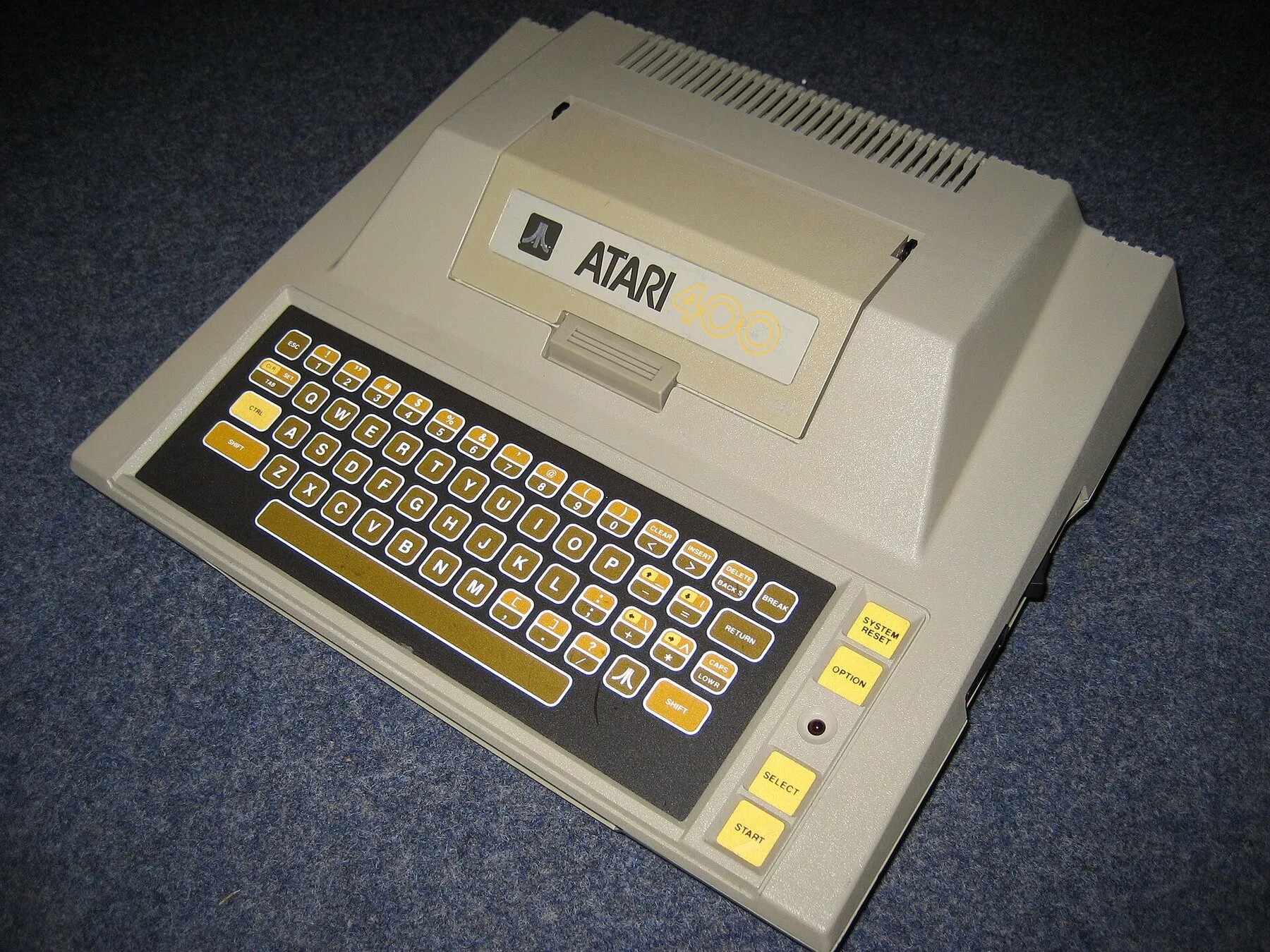
Memory boards inside the 800
Under the 800’s lid, a metal shield holds the two cartridge slots and, behind them, sockets for plug-in boards: the 10 KB operating system ROM board, which the FAQ calls the “Personality Module”, and up to three RAM modules, either the 8 KB CX852 or the 16 KB CX853. Antic wrote in 1984 that these slots were designed so memory could reach 48 KB, a figure Atari considered enough at the time while setting aside the rest of the address space “for housekeeping and future expansion”.
The memory fitted at the factory grew over the years, according to the FAQ:
- 1979 to 1980: 8 KB, on one CX852;
- from June 1980: 16 KB, on one CX853, with the 410 recorder no longer in the box;
- October 22 to December 31, 1982: two extra 16 KB modules given with the US$899 800, for 48 KB in total;
- from December 13, 1982: 48 KB as standard.
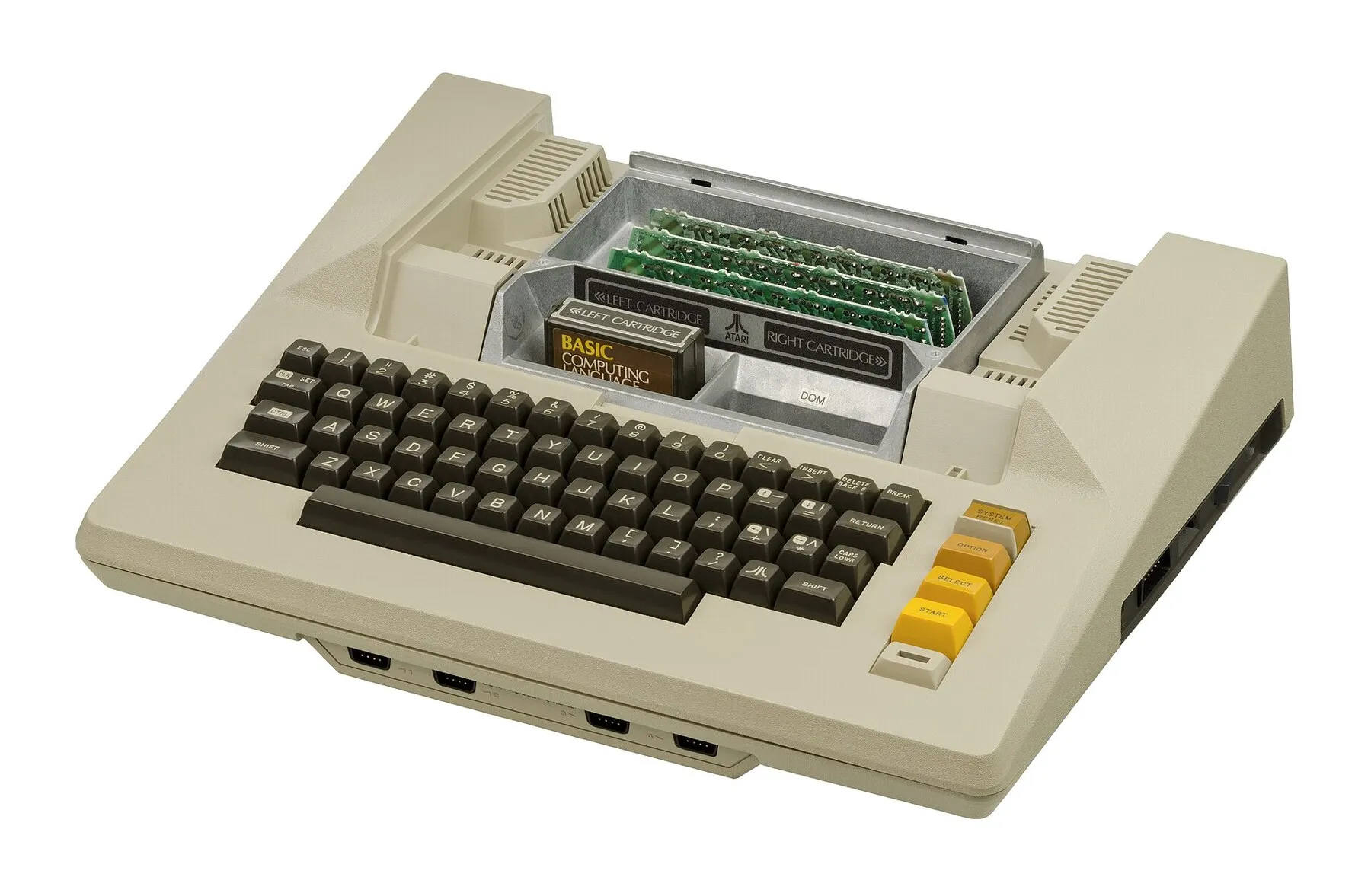
The 400 has no user memory slots. Antic noted that Atari “always considered” it complete at 16 KB, “even though other companies discovered ways to expand it”. The FAQ dates Atari’s own 48 KB kit for the 400 to June 1983. Compute! gave its prices in September 1983: US$110 from the Atari Program Exchange (APX) for owners fitting it themselves, or US$130 installed at Atari’s regional repair centers.
Changes during production
NTSC machines switched from CTIA to GTIA from November 1981 (PAL machines had always used GTIA). GTIA added three graphics modes, one of which shows 16 luminances of a single hue, which raises the palette from 128 to 256 colors. The same month the operating system moved to revision B, and new 810 drives received a faster ROM. Late units used SALLY, Atari’s version of the 6502. Prices moved both ways (dates from the FAQ):
- January 1980: the 400 and 800 packages raised to US$629.95 and US$1,079.95;
- May 1981: the 8 KB 400 dropped and the 16 KB 400 cut to US$399;
- December 30, 1981: the 800 cut to US$899;
- June 1982: the 400 cut to US$349;
- July 1982: the 400 cut to US$299;
- January 1983: the 800 cut to US$679;
- June 1, 1983: the 400 cut to US$149 and the 800 to US$499, before rebates.
In June 1983 Compute!’s editor wrote that the 400 was “now below $150” in stores. Sales figures from the period do not agree: InfoWorld reported in June 1982 that Atari claimed 300,000 computers sold in 1981, while its own estimate a month later was 250,000 to 300,000 sold in total.
End of production in 1983
The Atari 1200XL, shipped in March 1983, was meant to replace the 800. The FAQ dates the end of production at Sunnyvale to May 1983 for both computers; Atari also built 400s in Hong Kong from January to May 1983, and the last 800s there in May and June 1983. In the United States, Atari offered a US$50 rebate on the 400 from April 15 to September 30, 1983, and a US$100 rebate on the 800 from May 15 to October 31. At the Summer CES in Chicago in June 1983, Compute! reported, Atari discarded its entire lineup, “from the four-year-old 400 and 800 to the struggling 1200XL”, in favor of “four redesigned computers” in the XL series. The Atari 8-bit family page follows the line through the XL and XE models.
Sources
- Atari introduces the 400/800 computers (transcriptions of Creative Computing, April and August 1979), Michael Current
- Atari 8-Bit Computers: Frequently Asked Questions, Michael Current
- Joe Decuir interview, Atari Museum (Curt Vendel)
- BYTE News: Personal computer system deliveries delayed, Byte, vol. 5 no. 3, March 1980
- Data processing system with programmable graphics generator (US patent 4,296,476), Google Patents, October 20, 1981
- Inside Atari: Evolution of the XL Computers, Antic, vol. 3 no. 2, June 1984
- The Editor's Notes, Compute!, issue 37, June 1983
- The Fall Computer Collection At The Summer Consumer Electronics Show, Compute!, issue 39, August 1983
- News & Products: Atari 400 Expansion, Compute!, issue 40, September 1983
- Atari 8-bit computers, Wikipedia
Last reviewed October 30, 2026.
Related pages
- Atari 8-bit computer family
Atari's 6502 home computers, from the 400 and 800 of 1979 to the XE Game System of 1987, all built on ANTIC, CTIA or GTIA, and POKEY
- Atari 1200XL
The 64 KB successor to the Atari 800, announced in December 1982, shipped in March 1983 at US$899 and out of production by July
- Atari computers
The 8-bit line of 1979 to 1992, the ST family of 1985 to 1993, and Atari Corporation's PC compatibles, Portfolio palmtop and transputer workstation
- Atari corporate history: from Atari, Inc. to Atari SA
Atari, Inc., Warner, the 1984 split, Atari Corporation, Atari Games, JTS, Hasbro Interactive, Infogrames and Atari SA, with dates and prices