Atari 520ST
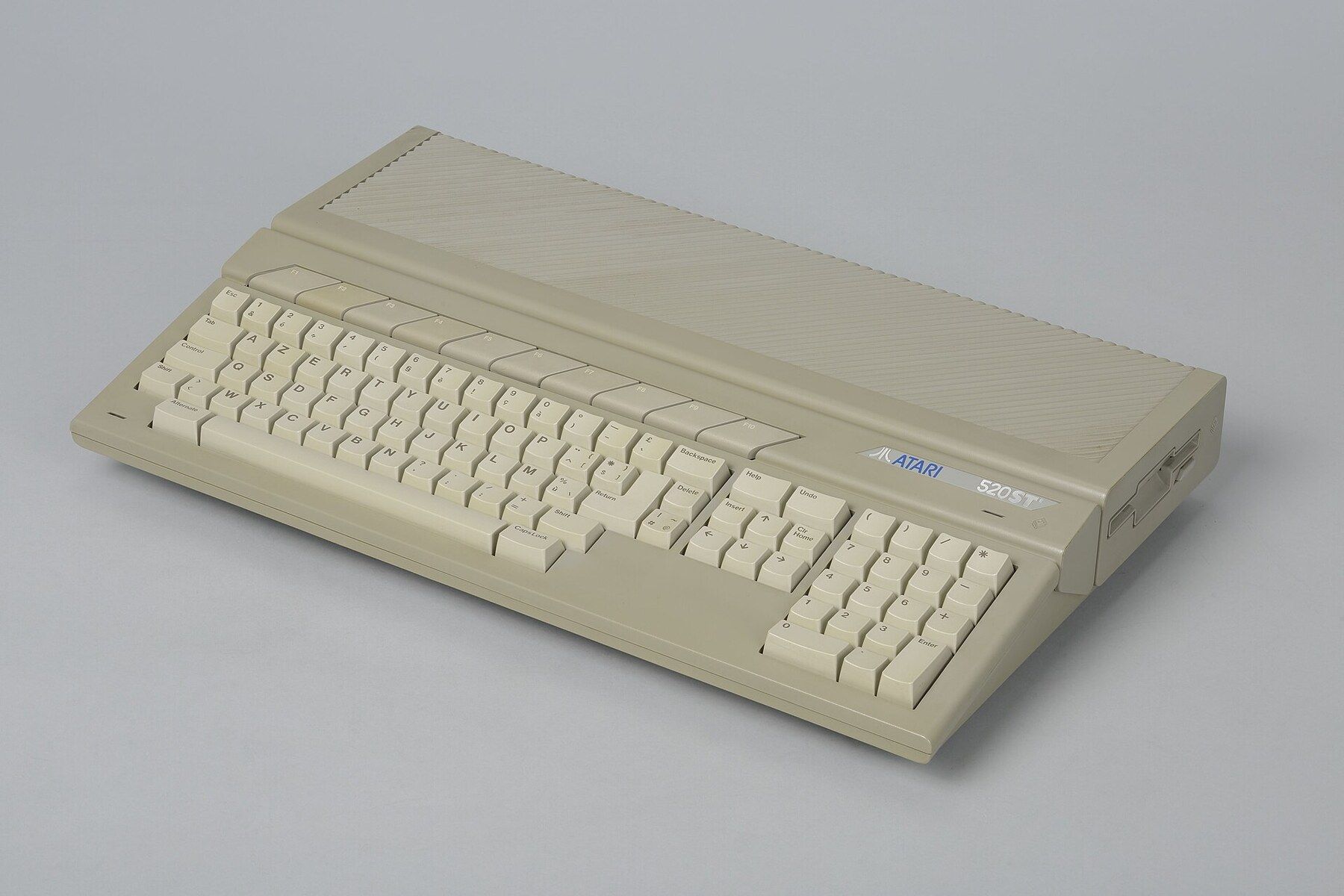
The Atari 520ST was the first computer of Atari Corporation’s ST line: a Motorola 68000 machine with 512 KB of RAM, a mouse-driven GEM desktop and MIDI ports built in. Atari Corporation showed it at the Winter Consumer Electronics Show in January 1985, about six months after Jack Tramiel took over Atari’s consumer business, and began shipping it to distributors in July 1985.
“ST” stands for Sixteen/Thirty-two, after the 68000’s 16-bit external bus and 32-bit registers.
Five months from takeover to CES
Tramiel and his team took control of Atari’s headquarters on July 2, 1984. The engineering effort was led by Shiraz Shivji, a former Commodore engineer who became Atari Corporation’s vice president for research and development. Looking back in START magazine in 1988, Shivji said the machine shown at CES had “real chips, with real PCBs, with real monitors, with real plastic”, and that five months earlier none of it existed.
The software was the tight part. Atari licensed Digital Research’s GEM graphical environment, which Digital Research had been building for the IBM PC. The five units shipped to Las Vegas for CES ran GEM on top of CP/M-68K. The disk operating system that replaced CP/M, GEMDOS, became part of TOS (The Operating System), which gave the ST a hierarchical file system with subdirectories. About 100 developer machines went out in the spring of 1985, and START reports that the first production 520STs came off the line in Taiwan in June.
Shipping in July 1985
The New York Times reported on July 10, 1985 that Atari had started shipping the 520ST to distributors, after a debut first planned for April. Atari’s marketing vice president, James Copland, said the company would ship “well in excess of 25,000” units over the following three or four weeks.
The prices quoted that summer were:
- US$799 for the computer, mouse, one floppy drive and a monochrome monitor, with Basic and Logo included;
- US$200 more for the color monitor instead;
- US$199 for a second single-sided drive.
The Los Angeles Times set it against the Amiga 1000, which started at US$1,295 with 256 KB. In December 1985 InfoWorld named the 520ST one of its products of the year, “an amazing computer for the price”, noting that features found on US$2,500 machines a year earlier now cost less than US$1,000.
Why TOS first shipped on a floppy disk
The ROM chips for TOS were not ready when the 520ST went on sale. Early machines loaded the operating system from a floppy disk into RAM at every start-up. The Los Angeles Times noted at the time that the operating system took up nearly half of the available memory, which left roughly 300 KB for programs. Atari fitted TOS in ROM to later machines and offered the ROMs as an upgrade for early ones; the first boards carry six ROM sockets for that purpose.
This is also why the planned 130ST (128 KB) and 260ST (256 KB) made little sense: a disk-loaded TOS would have left almost nothing free. The 260ST was only sold in small numbers in Europe.
What the hardware offered
The display depends on the monitor. On the color monitor the 520ST shows 320 × 200 pixels in 16 colors, or 640 × 200 in 4 colors, chosen from 512. The cheaper monochrome monitor gives a single 640 × 400 mode at about 71 Hz, sharp enough for text work; in Germany in particular the ST found a market in desktop publishing and CAD. A program supports either both monitor types or only one, and in practice most games required color while business software favored monochrome.
Two ports set the ST apart from other home computers of 1985:
- MIDI in and out. Synthesizers and drum machines connect without an interface box, which made the ST popular with musicians for sequencing.
- DMA port. Hard disks, and later Atari’s SLM804 laser printer, connect to this direct-memory-access port (ACSI), which moves data straight into the computer’s memory.
The first 520ST has no internal drive and no internal power supply. The SF354 drive and the power brick sit beside the keyboard unit, which explains the cable clutter in many photos of early setups.
Later 520 models
The name stayed in use while the hardware changed:
| Model | Change from the first 520ST |
|---|---|
| 520ST M | RF modulator, so the color modes work on a television |
| 520ST+ | 1 MB of RAM, still with an external drive |
| 520ST FM | Larger case with a built-in floppy drive, internal power supply and RF modulator |
| 520STE | Released in late 1989: DMA stereo sound, Blitter chip and a 4,096-color palette |
The 1040ST F of 1986 used the same design with 1 MB and a built-in double-sided drive. The Atari ST family page follows the line through the Mega ST, TT030 and Falcon030.
Sources
- Atari Is Shipping 520 ST Computer, The New York Times, July 10, 1985
- 2 New Gems Are Worth the Hunt, Los Angeles Times, August 19, 1985
- Three Years with the ST, START magazine, vol. 3 no. 1, Summer 1988
- Peripherals; Sampling of the Best 1985 Products, The New York Times, December 31, 1985
- The Atari 520ST Personal Computer System (archived Atari Historical Society page), Internet Archive, captured March 2000
- Atari ST, Wikipedia
Last reviewed October 30, 2026.
Related pages
- Atari ST family
Atari Corporation's 68000 and 68030 computers, from the 520ST of 1985 through the Mega ST, STE and TT030 to the Falcon030 of 1992
- Atari 8-bit computer family
Atari's 6502 home computers, from the 400 and 800 of 1979 to the XE Game System of 1987, all built on ANTIC, CTIA or GTIA, and POKEY
- Atari corporate history: from Atari, Inc. to Atari SA
Atari, Inc., Warner, the 1984 split, Atari Corporation, Atari Games, JTS, Hasbro Interactive, Infogrames and Atari SA, with dates and prices
- Atari technical documentation
Chip by chip and manual by manual, the documents that explain how Atari machines work, from the 1979 Stella guide to the Jaguar reference